

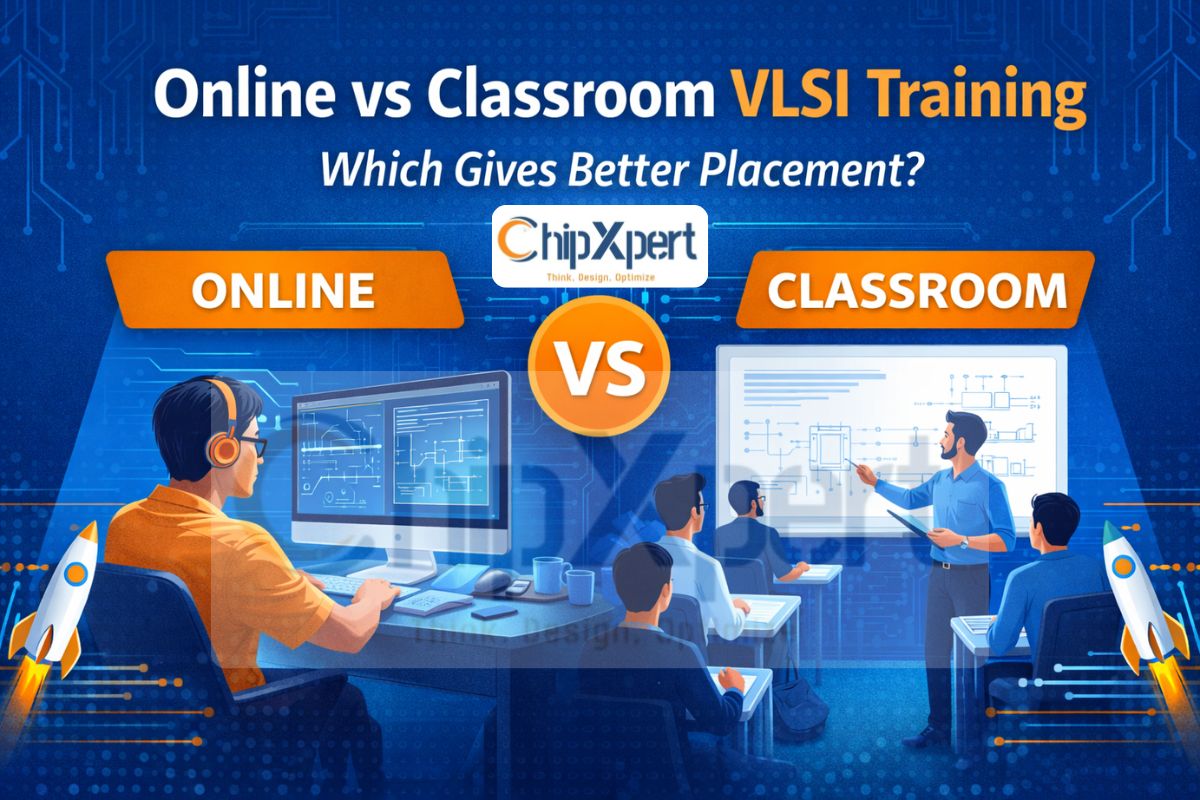
As the semiconductor industry continues to expand rapidly, VLSI training has become a crucial career investment for engineering students, fresh graduates, and working professionals. With chip design, verification, and physical design roles in high demand, one question is asked repeatedly:
Does online VLSI training give the same placement opportunities as classroom training?
The answer is not as simple as choosing one over the other. Placement success depends on how well the training builds real industry skills, not just where or how the classes are delivered.
Understanding What Companies Actually Look For
When semiconductor companies interview candidates, they rarely care whether the candidate learned online or in a classroom. What truly matters is whether the candidate can think like a VLSI engineer.
Interviewers focus on fundamentals such as digital design concepts, CMOS basics, and SoC understanding. They expect candidates to explain their project work confidently, understand real design flows, and show familiarity with tools and debugging approaches. In short, skills and exposure outweigh training format.
Online VLSI Training: How It Really Works
Online VLSI training has evolved significantly over the past few years. It is no longer limited to recorded videos or basic theory sessions. Many online programs now offer live instructor-led classes, remote lab access, and project mentoring.
The biggest advantage of online training is flexibility. Learners can attend sessions from anywhere, making it ideal for working professionals and students from smaller cities who may not have access to reputed classroom institutes. Online platforms also make it easier to learn from industry experts who are actively working on live semiconductor projects.
However, online learning requires strong self-discipline. Without a physical classroom environment, consistency depends entirely on the learner. Those who treat online classes casually often struggle to build depth in complex topics like STA, UVM, or physical design.
Classroom VLSI Training: The Traditional Advantage
Classroom training continues to attract many fresh graduates because of its structured and immersive environment. Daily face-to-face interaction with trainers, scheduled lab sessions, and peer discussions help learners stay focused and motivated.
For beginners, classroom training often makes it easier to grasp difficult concepts through whiteboard explanations and instant doubt clarification. Being surrounded by peers also helps in interview preparation and professional networking, which can be valuable during placement drives.
That said, classroom training is not without limitations. Fixed schedules may not suit working professionals, and relocation to major cities can significantly increase the overall cost. Most importantly, not all classroom institutes offer the same quality of trainers or project exposure.
From a Placement Perspective: What Makes the Real Difference
Placement outcomes depend far more on the quality of training than on the mode of delivery. Candidates who have worked on real-world projects, understand complete chip design or verification flows, and can confidently answer interview questions tend to perform well—regardless of whether they learned online or offline.
Institutes that focus on placement-oriented training usually offer resume preparation, mock interviews, and technical mentoring. These elements often have a greater impact on placement success than the classroom or online label.
Which One Should You Choose?
Online VLSI training works best for learners who are self-motivated, comfortable with independent study, and need flexibility due to jobs or academic commitments. Classroom training is often better suited for freshers who prefer guided learning, fixed routines, and hands-on lab environments.
Today, many reputed training providers offer a hybrid approach, combining online theory sessions with structured lab access and live project mentoring. This model is increasingly popular because it balances flexibility with discipline and practical exposure.
Final Thoughts
There is no universal answer to whether online or classroom VLSI training gives better placement. Placements are driven by skills, projects, and preparation—not by the training format.
If a program offers an industry-aligned curriculum, hands-on project work, expert mentorship, and strong placement support, it can deliver excellent results in either mode. The key is to choose a training path that matches your learning style, schedule, and long-term career goals.
In the semiconductor industry, what you know and what you can demonstrate matter far more than where you learned it.
Share your question in comments or talk to our mentor team for batch guidance.
Need Fee, Duration, or Demo Class Details?
Talk to our admin team for the latest batch plan and career guidance.
Contact Admin TeamAsk the Admin Team
Drop your basic question in comments: eligibility, prerequisites, tools, fee range, and placement support.
Our team reviews and responds regularly.