

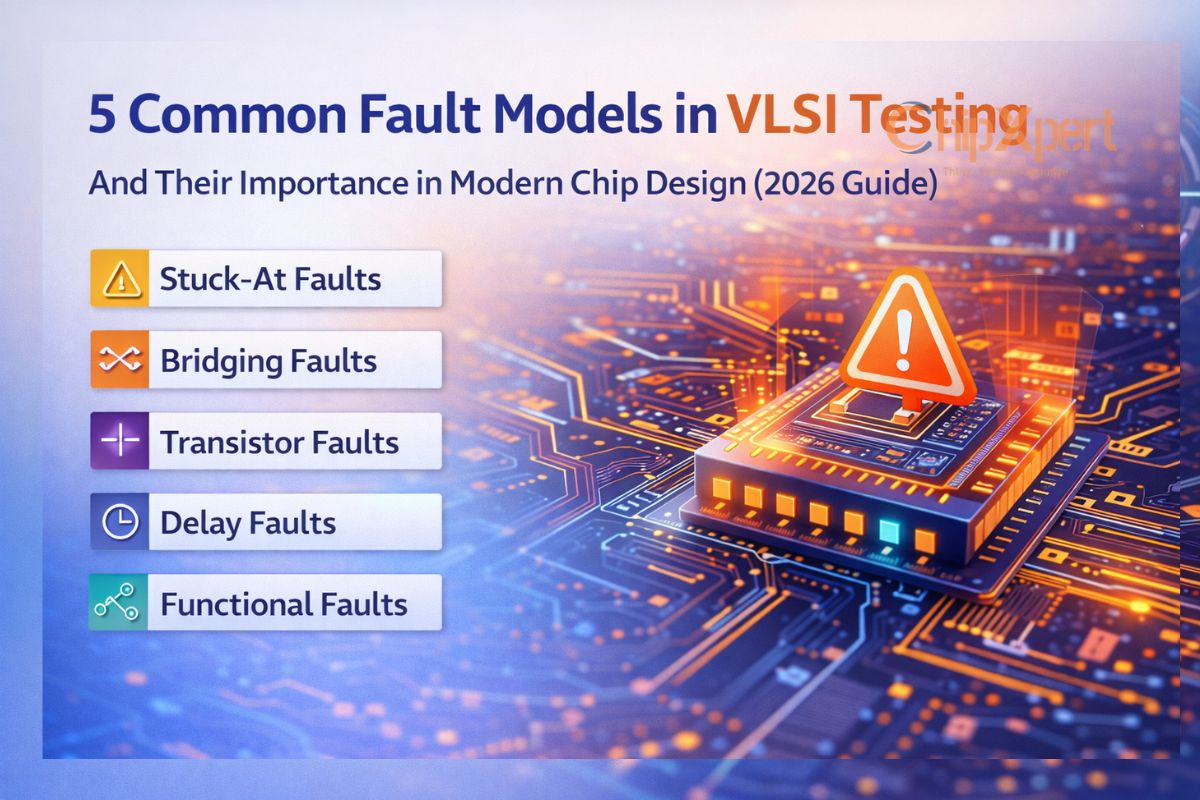
As semiconductor technology advances toward smaller process nodes and increasingly complex architectures, ensuring chip reliability has become more critical than ever. Modern integrated circuits contain billions of transistors, making it impossible to manually test every possible defect. To simplify this challenge, engineers rely on fault models.
Fault models provide a structured way to represent potential defects in a circuit so they can be detected through testing and simulation. These models help design engineers generate test patterns that reveal faults before chips are manufactured or deployed. By modeling typical hardware failures, engineers can significantly improve product quality and manufacturing yield.
In this article, we explore five widely used fault models in VLSI testing and discuss their importance in modern semiconductor design.
Understanding Fault Models in VLSI
A fault model is an engineering abstraction used to represent possible defects that may occur during the fabrication or operation of a digital circuit. Instead of analyzing every physical defect individually, designers use simplified fault models to predict how a circuit might behave when something goes wrong.
These models allow automated tools to generate test patterns that can detect potential failures early in the chip development process. Without fault models, testing modern integrated circuits would be extremely difficult due to their complexity.
1. Stuck-At Fault Model
The stuck-at fault is one of the most widely used models in digital circuit testing. In this scenario, a signal line becomes permanently stuck at a logic value of either 0 or 1 regardless of the intended input signal.
For example, if a signal line is stuck at logic 1, the circuit behaves as if that node always outputs a high signal even when the design expects it to change.
The stuck-at model is popular because it simplifies the detection of logical faults and works well with automated test pattern generation tools. Even though modern chips are far more complex, this model remains a fundamental part of digital test methodologies.
2. Bridging Fault Model
A bridging fault occurs when two signal lines that should remain separate become electrically connected due to manufacturing defects or layout issues. When this happens, the signals interfere with each other and produce incorrect outputs.
For instance, if two wires are unintentionally shorted together, the resulting logic value may behave like a wired-AND or wired-OR condition depending on circuit structure.
Bridging faults often arise in densely packed interconnect layers, especially in advanced semiconductor nodes where spacing between wires is extremely small.
3. Transistor Stuck-Open and Stuck-On Faults
At the transistor level, faults can occur when a transistor fails to switch properly. Two common transistor-level failures include stuck-open and stuck-on faults.
A stuck-open fault occurs when a transistor fails to conduct current, leaving the output node in a high-impedance state. On the other hand, a stuck-on fault happens when a transistor remains permanently conducting even when it should be turned off.
These faults can create unpredictable logic states and are particularly important when analyzing CMOS circuits.
4. Delay Fault Model
As chip frequencies increase and timing margins become tighter, delay faults have become increasingly important. A delay fault occurs when a signal transition takes longer than expected to propagate through a circuit.
This type of fault does not necessarily change the logical function of the circuit, but it can cause timing violations that lead to incorrect operation at high speeds. Delay faults are often classified into categories such as transition delay faults and path delay faults.
Testing for delay faults is essential for high-performance processors and modern system-on-chip devices.
5. Functional Fault Model
Functional faults represent errors that occur at the behavioral or system level rather than at the individual gate level. In this model, the circuit fails to perform its intended function even though individual components may appear to work correctly.
These faults often arise due to design logic errors, incorrect control signals, or complex interactions between different modules. Functional fault modeling is commonly used in processor verification and system-level testing.
Importance of Fault Models in Modern Chip Testing
Fault models play a vital role in the semiconductor design and manufacturing process. By simulating potential failures, engineers can develop targeted test patterns that detect defects before chips reach the market.
Key benefits of using fault models include:
- Improving manufacturing yield
- Detecting defects early in the design cycle
- Reducing the risk of faulty chips reaching customers
- Enhancing overall chip reliability
With the increasing complexity of AI accelerators, automotive processors, and advanced computing systems, effective fault modeling is more important than ever.
Fault Modeling Trends in 2026
In recent years, semiconductor testing has evolved significantly. Modern VLSI testing strategies combine traditional fault models with advanced techniques such as machine learning-based test optimization and cell-aware testing methods.
Engineers are also adopting more sophisticated defect models that capture real manufacturing variations. These approaches improve fault coverage and reduce test time while maintaining high product reliability.
Conclusion
Fault models are a fundamental part of VLSI testing and verification. By representing potential defects using simplified models such as stuck-at faults, bridging faults, transistor faults, delay faults, and functional faults, engineers can efficiently test complex integrated circuits.
As semiconductor technology continues to advance in 2026, the importance of accurate fault modeling will only increase. Reliable testing methodologies help ensure that modern chips meet the high performance and reliability requirements demanded by today’s electronics industry.
Share your question in comments or talk to our mentor team for batch guidance.
Need Fee, Duration, or Demo Class Details?
Talk to our admin team for the latest batch plan and career guidance.
Contact Admin TeamAsk the Admin Team
Drop your basic question in comments: eligibility, prerequisites, tools, fee range, and placement support.
Our team reviews and responds regularly.