

As an ECE student in 2026, the transition from your third year to your final year is a defining moment. The semiconductor industry is no longer looking for generic projects that just “work” on a breadboard. Recruiters at top tier firms are searching for “tape-out intent”—the ability to take a complex specification and move it through a professional VLSI flow.
At ChipXpert, we believe that your final year project should be your professional calling card. It is not just an academic requirement; it is a demonstration of your command over RTL coding, verification, and physical implementation. Here are five advanced project ideas designed to put you at the front of the hiring line in the 2026 silicon market.
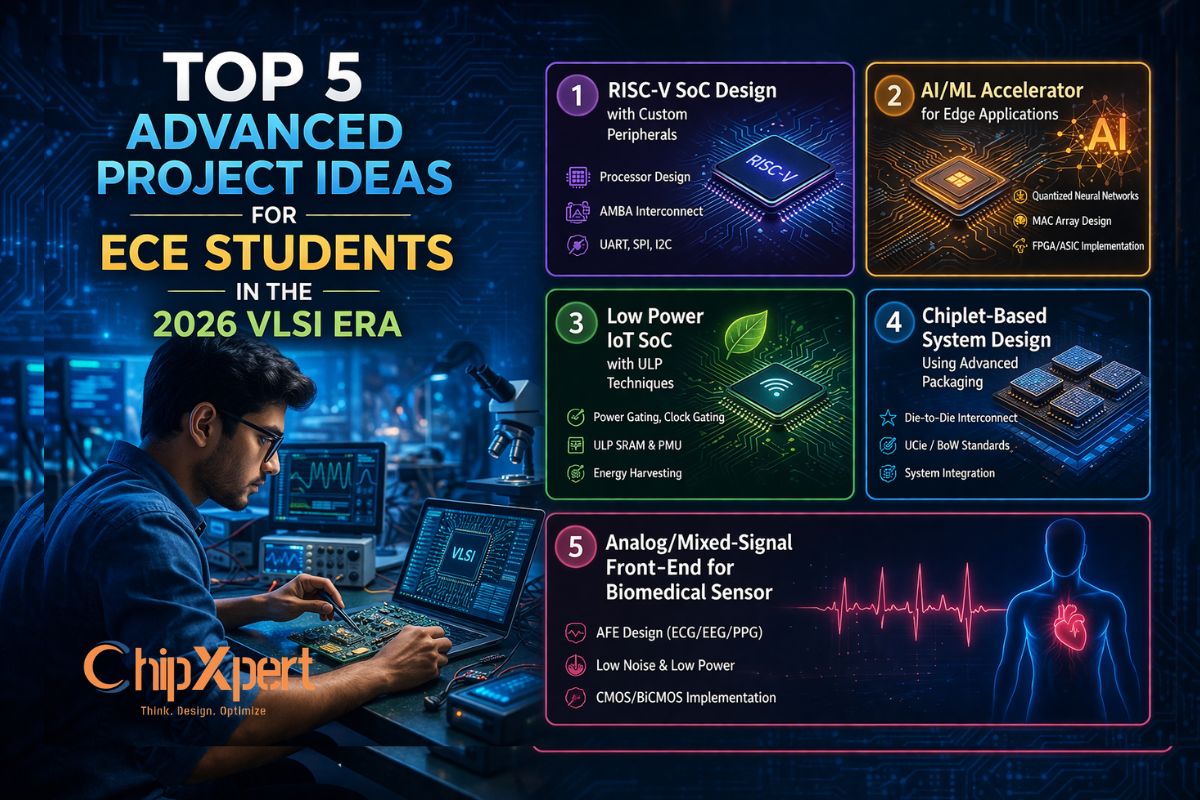
1. Custom RISC-V Processor with Security Extensions
The world has embraced RISC-V as the open standard for the next generation of computing. Instead of just implementing a basic 3-stage pipeline, an advanced project in 2026 involves adding custom “Physical AI” or “Security” extensions.
For this project, you could design a 5-stage pipelined RISC-V core and integrate a Hardware Root of Trust (RoT) module. This module would handle secure boot and encrypted instruction fetching. This project demonstrates your ability to handle complex control logic and your understanding of the modern “Security-First” hardware paradigm.
2. AI Hardware Accelerator for Edge Inference
With the rise of “Small AI,” the industry is desperate for low power accelerators that can run neural networks on the edge. An excellent project involves designing a specialized Multiply-Accumulate (MAC) array optimized for 4-bit or 8-bit integer quantization (INT4/INT8).
You can implement a systolic array architecture that interfaces with a standard bus like AXI4-Lite. By prototyping this on an FPGA and showing the power-per-inference metrics, you prove to employers that you understand the critical trade-offs between computational throughput and thermal envelopes.
3. High-Speed Memory Controller with ECC
In the 2026 landscape of High Bandwidth Memory (HBM3) and DDR5, memory bottlenecks are a major challenge. A highly sophisticated project is to design a high speed Memory Controller that includes Error Correction Code (ECC) logic.
This project challenges you to manage complex timing relationships and data integrity. You would implement a controller that can detect and correct single-bit errors and detect double-bit errors (SEC-DED). Mastering the handshake protocols between the processor and the memory PHY is a skill that is in extremely high demand at companies like Micron and Samsung.
4. UVM-Based Verification of a Communication Protocol
If your goal is to become a Design Verification (DV) engineer, your project should focus on the “Check” rather than the “Design.” Choose a complex protocol like PCIe Gen4 or a multi-channel DMA controller and build a complete Universal Verification Methodology (UVM) environment for it.
Your project should include a stratified testbench with agents, monitors, scoreboards, and a functional coverage plan. Showing a recruiter a “Coverage Closure Report” where you have mathematically proven that you tested 100% of the protocol corner cases is the fastest way to get hired in 2026.
5. Low-Power Physical Design of a 2nm Block
For those interested in the “Physical” side of VLSI, this project focuses on the backend. Take an open-source IP, like a DES encryption engine, and move it through a full Physical Design flow—from Synthesis and Floorplanning to Placement, Clock Tree Synthesis (CTS), and Routing.
Using industry-standard tools available at ChipXpert, you can target a sub-7nm process node. Your project outcome would be the final GDSII file along with a detailed report on “Power, Performance, and Area” (PPA) optimization. Specifically, showing how you solved “IR Drop” issues using Backside Power Delivery concepts will set your project apart from thousands of others.
Why Project Quality Matters at ChipXpert
At ChipXpert, we don’t just teach you the syntax of SystemVerilog or the steps of a layout tool. We mentor you to think like a Silicon Architect. An advanced project is a journey through the “Silicon Lifecycle.”
- Documentation: Learn to write a professional Design Document.
- Peer Review: Get your RTL code reviewed by industry veterans.
- Validation: Prove your results with rigorous simulation and timing analysis.
Conclusion: Your Project, Your Future
The ECE landscape of 2026 is competitive, but it is also full of unprecedented opportunity. The transition to AI, RISC-V, and advanced 3D packaging means that there is a “knowledge vacuum” that fresh engineers can fill.
By choosing an advanced project that aligns with these industry trends, you are telling the world that you are ready for the challenges of the 2nm era. Use your final year to build something that lasts—not just a circuit, but a foundation for a lifelong career in silicon. At ChipXpert, we are ready to help you turn these ideas into the “Magic” that shapes tomorrow.
Looking for a wider range, including beginner and intermediate options? See our full guide to VLSI projects for ECE students — 15 ideas from a 4-bit ALU up to a complete RTL-to-GDSII flow.
Share your question in comments or talk to our mentor team for batch guidance.
Need Fee, Duration, or Demo Class Details?
Talk to our admin team for the latest batch plan and career guidance.
Contact Admin TeamAsk the Admin Team
Drop your basic question in comments: eligibility, prerequisites, tools, fee range, and placement support.
Our team reviews and responds regularly.