

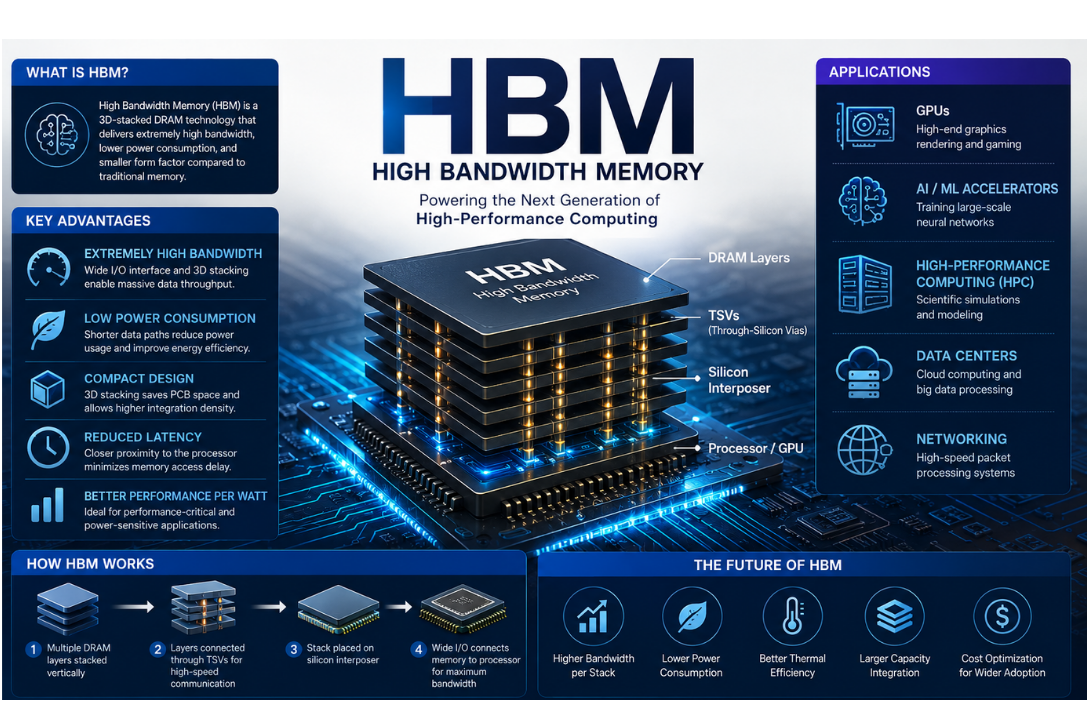
High Bandwidth Memory (HBM) is an advanced DRAM technology designed to deliver significantly higher data bandwidth with lower power consumption compared to traditional memory solutions like DDR and GDDR. It is primarily used in high-performance computing (HPC), artificial intelligence (AI) accelerators, GPUs, and data centers where memory throughput is a critical bottleneck.
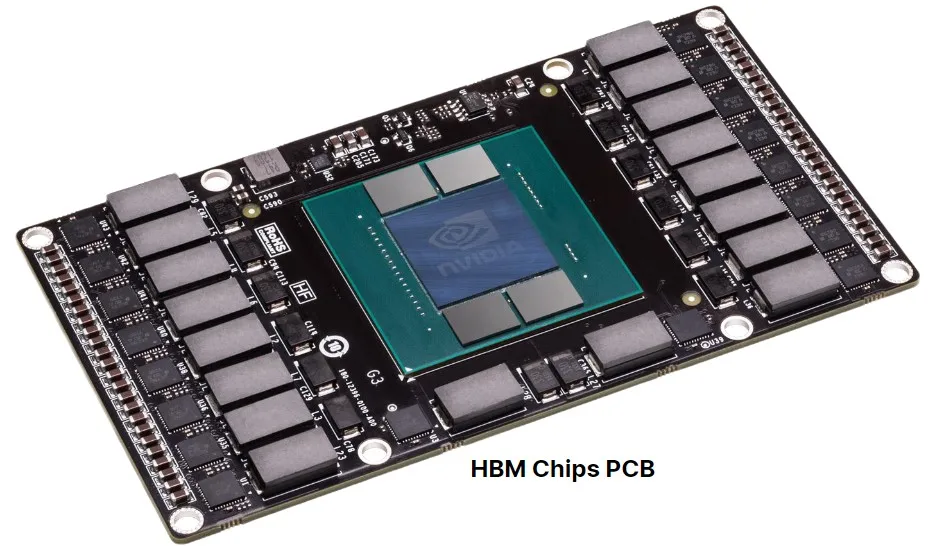
Unlike conventional memory placed across a PCB, HBM uses a 3D-stacked architecture that brings memory closer to the processor, improving speed and efficiency.
Key Advantages of HBM Technology
HBM offers several performance and efficiency benefits that make it essential for modern computing systems:
- Ultra-High Bandwidth: Enables massive parallel data transfer for AI and GPU workloads
- Low Power Consumption: Reduced data travel distance leads to improved energy efficiency
- Compact Form Factor: 3D stacking saves PCB space and improves integration density
- Reduced Latency: Close coupling with processors minimizes memory access delay
- Improved Performance per Watt: Ideal for energy-sensitive data center applications
These advantages make HBM a preferred choice for next-generation compute-intensive workloads.
Challenges and Limitations of HBM
Despite its advantages, HBM technology has certain constraints:
- High Manufacturing Cost: Complex 3D stacking and interposer integration increase production cost
- Thermal Management Issues: Dense stacking leads to heat dissipation challenges
- Limited Scalability: Difficult to scale compared to traditional DRAM technologies
- Complex Packaging: Requires advanced semiconductor packaging techniques
These challenges restrict HBM adoption mainly to premium and high-performance applications.
Applications of HBM in Modern Industry
HBM is widely used in domains where memory bandwidth is critical:
- GPUs: High-end graphics rendering and gaming performance
- AI/ML Accelerators: Training large-scale neural networks
- High-Performance Computing (HPC): Scientific simulations and modeling
- Data Centers: Cloud computing and large-scale data processing
- Networking Equipment: High-speed packet processing systems
As AI workloads continue to grow, HBM plays a crucial role in eliminating memory bottlenecks.
Future Trends in HBM Technology
The evolution of HBM is rapidly advancing with each generation (HBM2, HBM2E, HBM3, and upcoming HBM4):
- Higher bandwidth per stack
- Lower power consumption per bit
- Improved thermal efficiency
- Greater memory capacity integration
- Better cost optimization for large-scale adoption
With the rise of generative AI, large language models, and HPC workloads, HBM is expected to become a core memory technology in future semiconductor architectures.
Conclusion
High Bandwidth Memory (HBM) represents a major shift in memory design, enabling faster, more efficient, and compact data processing systems. Although it faces challenges in cost and manufacturing complexity, its performance benefits make it indispensable for AI, HPC, and GPU-driven applications. As semiconductor innovation continues, HBM will remain a key enabler of next-generation computing performance.
Share your question in comments or talk to our mentor team for batch guidance.
Ask the Admin Team
Drop your basic question in comments: eligibility, prerequisites, tools, fee range, and placement support.
Our team reviews and responds regularly.