

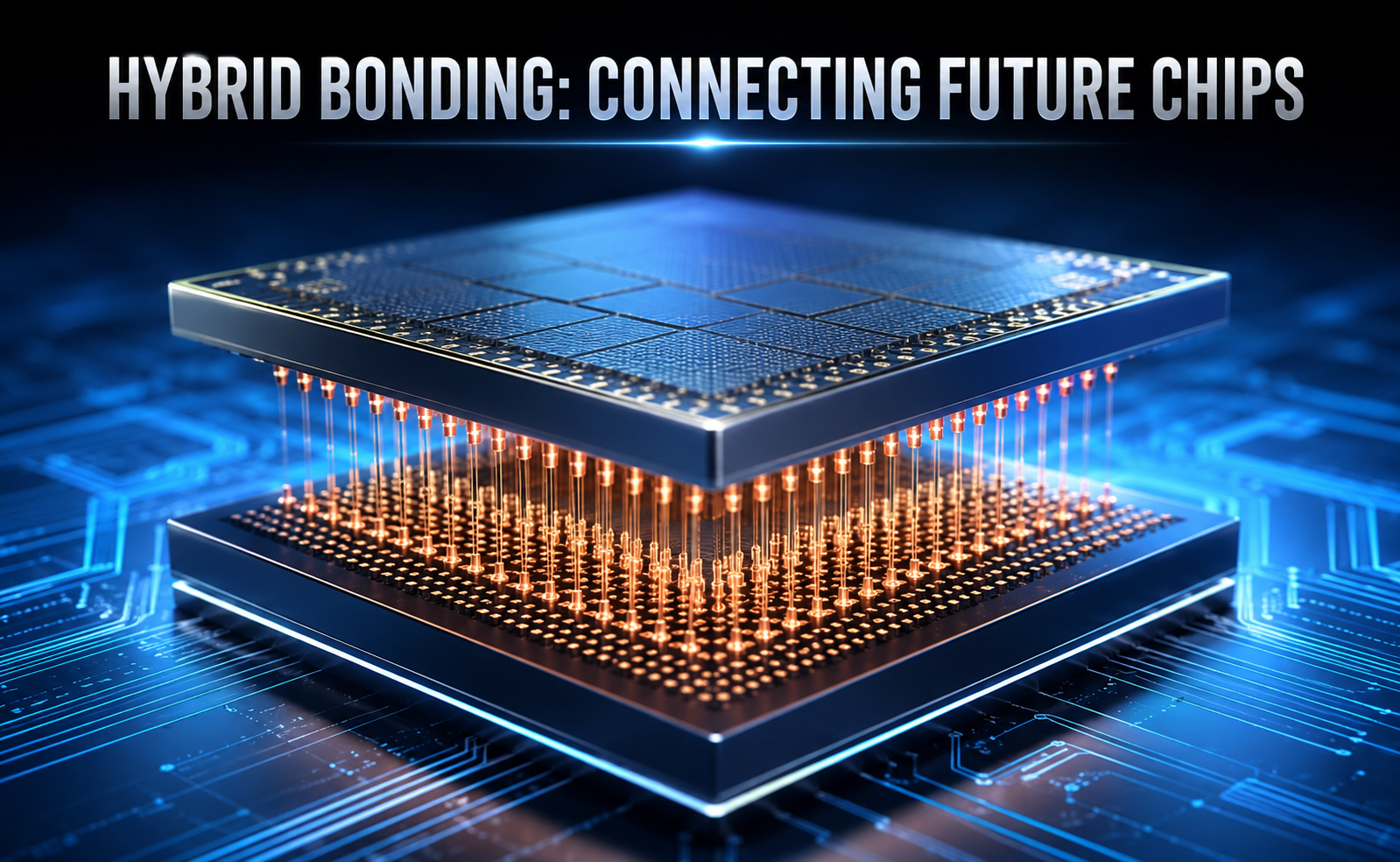
As semiconductor scaling reaches physical limits, the industry is moving beyond traditional transistor shrinking toward advanced 3D chip integration. Hybrid bonding has emerged as a breakthrough packaging technology that enables chips to connect with ultra-high density, low power, and high-speed communication.
It allows multiple dies to work together as a single powerful system, supporting future technologies like AI processors, high-performance computing, and advanced memory architectures.
What is Hybrid Bonding?
Hybrid bonding is an advanced packaging technique that directly connects two semiconductor dies using:
- Copper-to-copper interconnects for electrical connections
- Dielectric-to-dielectric bonding for mechanical strength
Unlike traditional methods that use solder bumps or microbumps, hybrid bonding creates a much finer connection between chips, enabling smaller pitch sizes and improved performance.
How Hybrid Bonding Works?
The process involves several precise steps:
Surface Preparation → Alignment → Bonding → Annealing
- Chip surfaces are polished and cleaned to achieve extreme flatness
- Dies are aligned with nanometer-level accuracy
- Dielectric layers bond first
- Copper contacts connect during thermal processing
This creates a strong, reliable, and high-bandwidth chip-to-chip connection.
Why Hybrid Bonding Matters?
Hybrid bonding offers major advantages for next-generation semiconductor designs:
Higher Bandwidth
→ Enables faster data movement between chiplets and memory
Lower Power Consumption
→ Reduces energy loss compared to traditional interconnects
Higher Density Integration
→ Supports compact 3D stacking of multiple dies
Better Performance
→ Improves speed for AI and data-intensive applications
Applications Driving Adoption
Hybrid bonding is becoming important in several emerging areas:
- AI Accelerators – Faster communication between compute units and memory
- 3D Chiplets – Combining different process technologies in one package
- Advanced Memory – High-density stacked memory solutions
- High-Performance Computing – Improved processing efficiency
It is becoming a key technology for future heterogeneous integration.
Future of Hybrid Bonding
The future of semiconductor innovation will depend not only on smaller transistors but also on smarter ways to connect chips.
Hybrid bonding is paving the way for:
- More powerful AI systems
- Energy-efficient processors
- Next-generation chiplet architectures
- Advanced 3D semiconductor platforms
Advanced Packaging Technologies
Heterogeneous Integration depends heavily on advanced packaging techniques such as:
- 2.5D Integration: Multiple dies placed side-by-side on an interposer
- 3D Integration: Chips stacked vertically for shorter connections
- Hybrid Bonding: Direct die-to-die connections for high density and speed
These technologies improve bandwidth, reduce latency, and increase system efficiency.
Share your question in comments or talk to our mentor team for batch guidance.
Ask the Admin Team
Drop your basic question in comments: eligibility, prerequisites, tools, fee range, and placement support.
Our team reviews and responds regularly.