

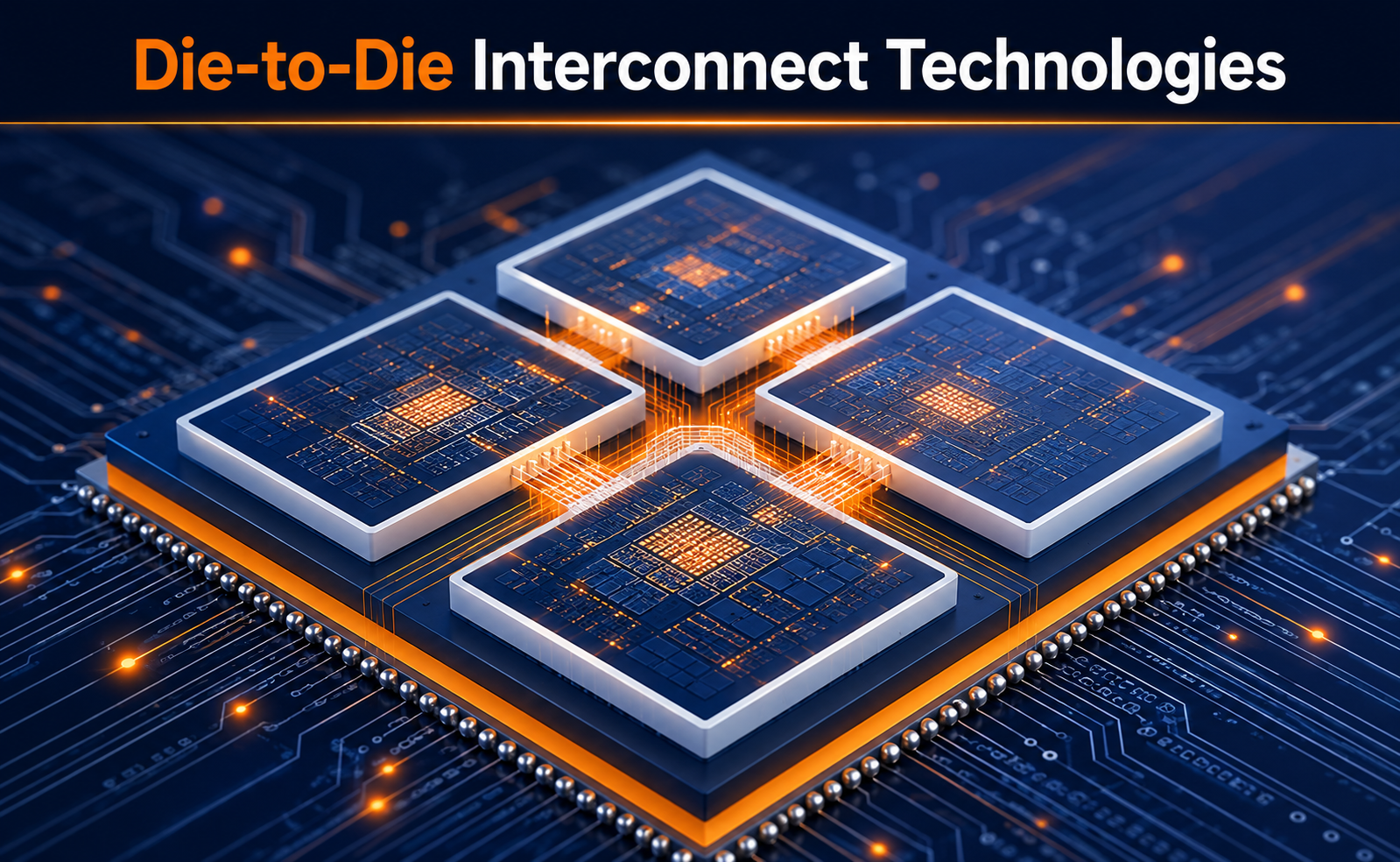
As semiconductor scaling becomes more challenging, building a complete system on a single large chip is becoming expensive and complex. Modern processors are moving toward chiplet-based architectures, where multiple smaller dies are connected together to work as one powerful system.
Die-to-Die (D2D) interconnect technology enables fast communication between these separate chiplets, making next-generation CPUs, GPUs, AI accelerators, and advanced packages possible.
What is Die-to-Die Interconnect?
Die-to-Die interconnect is a technology that connects two or more semiconductor dies inside a single package.
Instead of placing all functions on one large silicon die, manufacturers divide them into smaller blocks such as:
- Compute chiplets
- Memory chiplets
- I/O chiplets
- Accelerator dies
These dies communicate through high-speed interconnect pathways.
Role of D2D in Modern Chips
Die-to-Die technology is transforming semiconductor design:
AI and High-Performance Computing
- Connects compute engines with high-bandwidth memory
- Enables powerful AI accelerators
Advanced Processors
- Allows mixing different process nodes
- Improves performance and reduces manufacturing cost
3D Chip Integration
- Supports stacked chip designs
- Enables higher transistor density
D2D interconnects are becoming a key foundation for future heterogeneous integration.
Advantages and Challenges
Advantages:
Higher performance through shorter connections
Better yield using smaller dies
Lower manufacturing cost
Flexible chip design
Supports advanced packaging
Challenges:
- Managing heat in dense packages
- Maintaining signal integrity
- Complex testing and verification
- Power delivery optimization
Future of Die-to-Die Technology
The future of computing depends heavily on advanced chiplet integration.
Emerging applications include:
- AI data centers
- Next-generation GPUs
- High-performance processors
- 3D integrated systems
- Custom semiconductor solutions
Die-to-Die interconnect technology is becoming the bridge that connects the future of modular, powerful, and efficient chips.
Share your question in comments or talk to our mentor team for batch guidance.
Ask the Admin Team
Drop your basic question in comments: eligibility, prerequisites, tools, fee range, and placement support.
Our team reviews and responds regularly.