

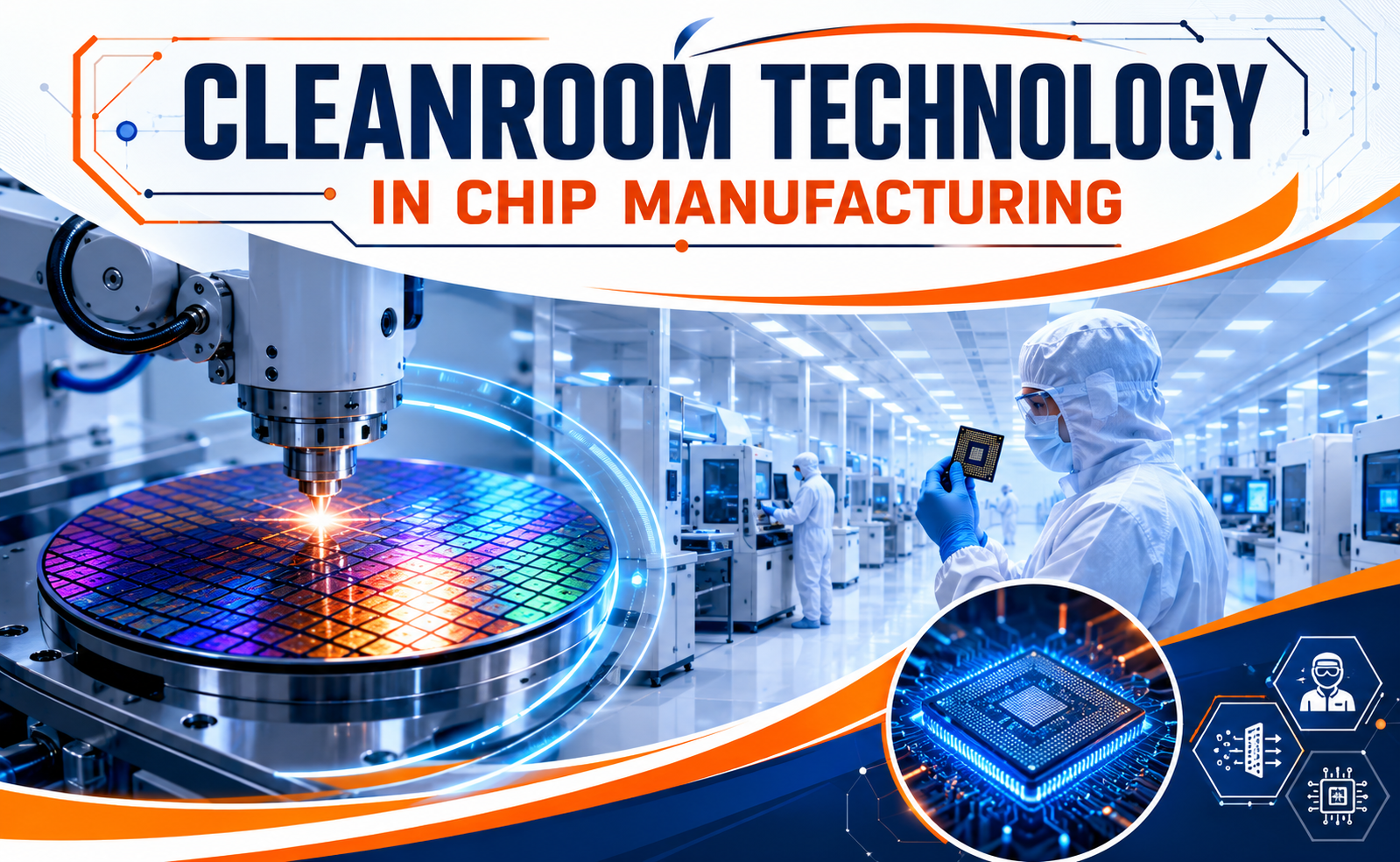
A cleanroom is a highly controlled environment designed to minimize contamination during semiconductor manufacturing. Since modern chips contain billions of tiny transistors, even microscopic particles can affect performance and yield.
Why Cleanrooms Are Critical in Semiconductor Manufacturing
During chip fabrication, wafers go through hundreds of precise processes. A single particle on a wafer can create defects in circuits and reduce chip reliability.
Key Points:
- Protects silicon wafers from defects
- Improves manufacturing yield
- Enables production of smaller technology nodes
Cleanroom Classification and Standards
Cleanrooms are classified based on the number of particles present in the air. Semiconductor fabs require extremely high cleanliness levels.
Key Points:
- ISO cleanroom standards define particle limits
- Advanced fabs use ultra-clean environments
- Lower particle count enables smaller transistor sizes
Technologies Used in Semiconductor Cleanrooms
Modern cleanrooms use advanced systems to maintain contamination-free conditions.
Key Technologies:
- HEPA/ULPA Filters: Remove airborne particles
- Laminar Airflow: Provides uniform clean air movement
- Ultra-Pure Water Systems: Used for wafer cleaning
- Controlled Temperature & Humidity: Protects process stability
Cleanrooms in Advanced Chip Manufacturing
As semiconductor technology advances, cleanroom requirements become more demanding. Processes like EUV lithography and 3D chip integration need extremely controlled environments.
Conclusion
Cleanroom technology is the invisible backbone of semiconductor manufacturing. It enables the production of powerful processors, memory devices, and advanced electronic systems by maintaining the extreme precision required in modern chip fabrication.
Share your question in comments or talk to our mentor team for batch guidance.
Ask the Admin Team
Drop your basic question in comments: eligibility, prerequisites, tools, fee range, and placement support.
Our team reviews and responds regularly.