

The semiconductor industry is continuously evolving to achieve higher performance, faster processing, and lower power consumption. With the rapid growth of artificial intelligence, cloud computing, and advanced communication systems, traditional electronic chips are facing challenges in handling massive data transfer requirements.
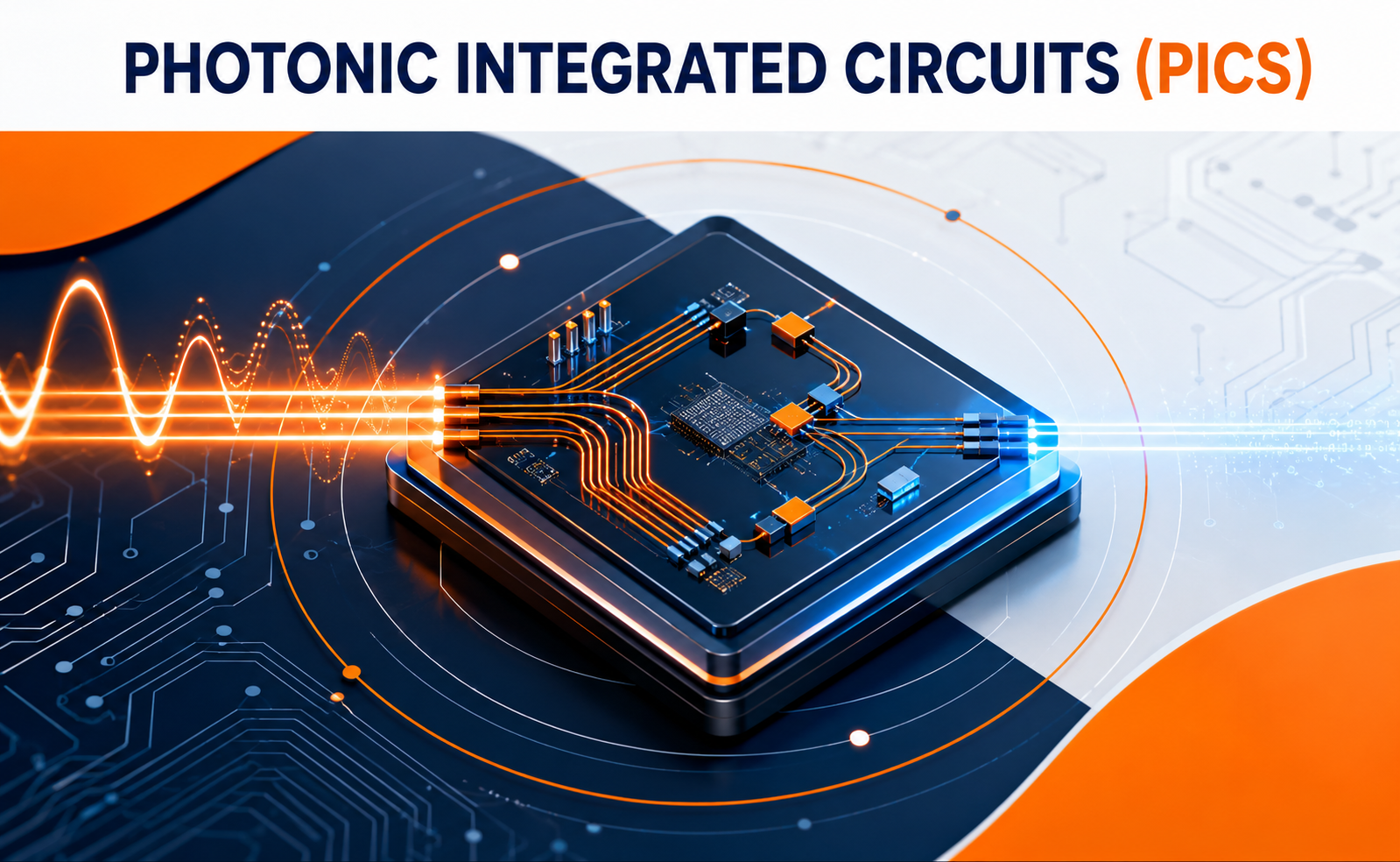
Photonic Integrated Circuits (PICs) are an emerging semiconductor technology that uses light signals (photons) to transmit and process information. By integrating photonics with semiconductor technology, PICs enable high speed communication, efficient computing, and next generation chip designs.
What is a Photonic Integrated Circuit (PIC)?
A Photonic Integrated Circuit (PIC) is a semiconductor chip that integrates multiple optical and electronic components on a single platform to control and process light signals.
Unlike traditional integrated circuits that mainly use electrical signals, PICs use photons for data transmission, offering improved speed and efficiency.
Key components of PICs include:
- Optical waveguides
- Lasers
- Modulators
- Photodetectors
- Optical switches
PIC Technology in Semiconductor Manufacturing
Photonic Integrated Circuits are developed using advanced semiconductor fabrication techniques similar to conventional chip manufacturing.
The manufacturing process includes:
- Wafer fabrication
- Advanced lithography
- Material deposition
- Etching processes
- Chip packaging and integration
Common materials used in PIC technology include:
- Silicon
- Silicon Nitride
- Indium Phosphide
- Gallium Arsenide
Silicon photonics is becoming a major technology because it enables integration with existing semiconductor processes.
Applications of Photonic Integrated Circuits
- Artificial Intelligence and Machine Learning systems
- Data centers and cloud computing infrastructure
- High speed optical communication networks
- Fiber optic and next generation communication systems
- High performance computing platforms
- LiDAR and advanced sensing technologies
- Medical and industrial sensing applications
- Quantum communication and computing systems
Advantages of Photonic Integrated Circuits
- Faster data transmission using light signals
- Lower power consumption
- Higher bandwidth capacity
- Reduced communication delays
- Improved signal efficiency
- Compact chip integration
- Better performance for AI and computing applications
- Supports future semiconductor innovations
Conclusion
Photonic Integrated Circuits are transforming the semiconductor industry by bringing optical technology into modern chip architectures. They provide solutions for increasing demands in computing speed, data communication, and energy efficiency.
As semiconductor technology moves toward advanced architectures, AI driven systems, and high performance computing, PICs will become a key technology shaping the future of electronics. By combining the speed of light with semiconductor innovation, PICs are paving the way for faster, smarter, and more efficient computing systems.
Share your question in comments or talk to our mentor team for batch guidance.
Ask the Admin Team
Drop your basic question in comments: eligibility, prerequisites, tools, fee range, and placement support.
Our team reviews and responds regularly.