

As modern electronic devices become smaller, faster, and more powerful, the semiconductor industry faces increasing pressure to integrate multiple functions into compact, energy efficient solutions. Traditional single chip designs often struggle to meet the growing demands of advanced applications such as smartphones, wearables, automotive systems, AI devices, and IoT products.
System-in-Package (SiP) has emerged as a transformative semiconductor packaging technology that integrates multiple integrated circuits (ICs) and passive components into a single package. By combining different technologies within one compact module, SiP delivers higher performance, reduced power consumption, and greater design flexibility.
What is System-in-Package (SiP)?
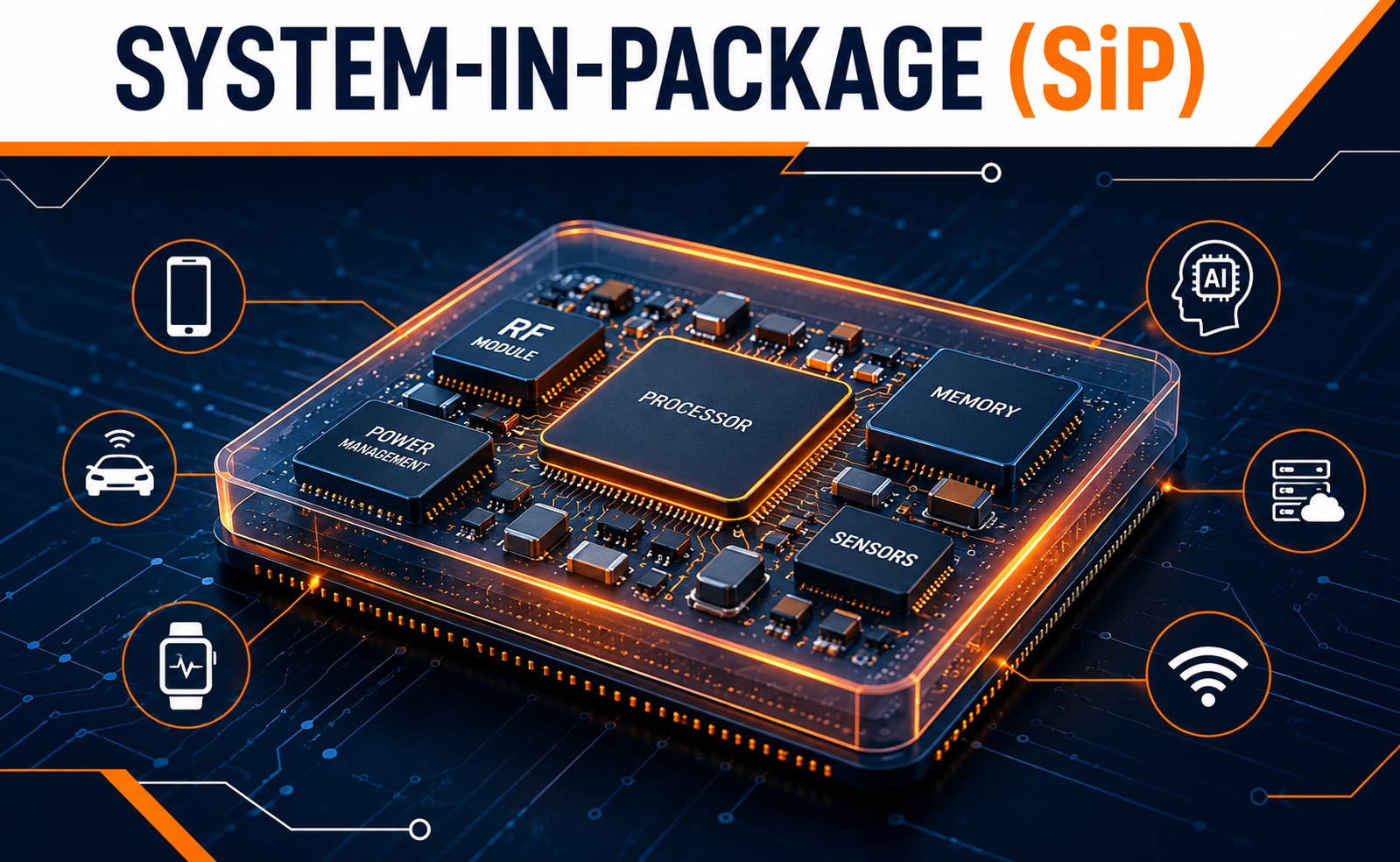
System-in-Package (SiP) is an advanced semiconductor packaging approach that integrates multiple semiconductor dies and supporting components into a single package, allowing them to function as one complete electronic system.
Unlike a traditional single chip package, an SiP may include:
- Processor (CPU or MCU)
- Memory (DRAM, SRAM, Flash)
- RF components
- Power management ICs
- Sensors
- Passive components such as resistors, capacitors, and inductors
All these components are interconnected within the same package, enabling higher functionality while minimizing board space.
Why System-in-Package is Transforming the Semiconductor Industry
As electronic devices continue to shrink in size, manufacturers require solutions that provide greater functionality without increasing product dimensions.
System-in-Package addresses these challenges by offering:
- Higher integration density
- Smaller overall footprint
- Faster communication between components
- Lower power consumption
- Simplified PCB design
- Improved system reliability
These advantages make SiP an ideal choice for compact, high-performance electronic products.
How System-in-Package Works
The SiP manufacturing process combines multiple semiconductor dies into a single package using advanced packaging technologies.
The general workflow includes:
- Individual semiconductor dies are fabricated.
- Dies are stacked or placed side-by-side.
- Advanced interconnect technologies connect the components.
- Passive components are integrated within the package.
- The complete module is encapsulated and tested as a single system.
Depending on the application, SiP may use:
- 2D packaging
- 2.5D integration
- 3D stacking
- Through-Silicon Vias (TSVs)
- Fan-Out Packaging
- Chiplet-based integration
These technologies improve signal integrity while reducing latency and power consumption.
Applications of System-in-Package
System-in-Package is widely adopted across numerous semiconductor applications due to its compact design and high integration capabilities.
Common applications include:
Smartphones and Tablets
Integrates processors, memory, RF modules, and power management into compact mobile devices.
Wearable Electronics
Enables lightweight smartwatches, fitness trackers, AR/VR headsets, and medical wearables.
Automotive Electronics
Supports advanced driver-assistance systems (ADAS), infotainment, radar, LiDAR, and autonomous vehicle technologies.
Artificial Intelligence and Edge Computing
Provides compact, high-performance modules for AI accelerators and edge devices.
Internet of Things (IoT)
Facilitates energy-efficient and space-saving solutions for smart home, industrial automation, healthcare, and connected devices.
Advantages and Challenges of SiP Technology
Key Advantages
- High component integration
- Compact package size
- Improved electrical performance
- Lower power consumption
- Faster system communication
- Greater design flexibility
- Reduced PCB complexity
- Faster product development cycles
Current Challenges
Despite its benefits, SiP presents several engineering challenges:
- Complex package design
- Advanced thermal management requirements
- Higher manufacturing costs
- Increased testing complexity
- Precision assembly processes
Continuous innovation in advanced packaging technologies is helping overcome these challenges.
Conclusion
System-in-Package represents a significant evolution in semiconductor packaging by integrating multiple functions into a single, compact module. It enables higher performance, improved energy efficiency, and greater functionality while meeting the industry’s growing demand for miniaturization.
As advanced packaging continues to shape the future of semiconductor manufacturing, System-in-Package will remain a cornerstone technology powering smarter, faster, and more connected electronic devices across every major industry.
Share your question in comments or talk to our mentor team for batch guidance.
Ask the Admin Team
Drop your basic question in comments: eligibility, prerequisites, tools, fee range, and placement support.
Our team reviews and responds regularly.