

As semiconductor technology continues to advance, modern System-on-Chip (SoC) devices integrate dozens or even hundreds of processing elements, memory blocks, AI accelerators, and specialized hardware into a single chip. Traditional communication methods, such as shared buses, struggle to efficiently handle the increasing volume of data exchanged between these components.
Network-on-Chip (NoC) has emerged as an advanced on-chip communication architecture that replaces conventional bus-based interconnects with a scalable network. By enabling high-speed, low-latency, and energy-efficient communication between multiple processing elements, NoC has become a fundamental technology for next-generation processors, AI accelerators, and high-performance computing systems.
What is Network-on-Chip (NoC)?
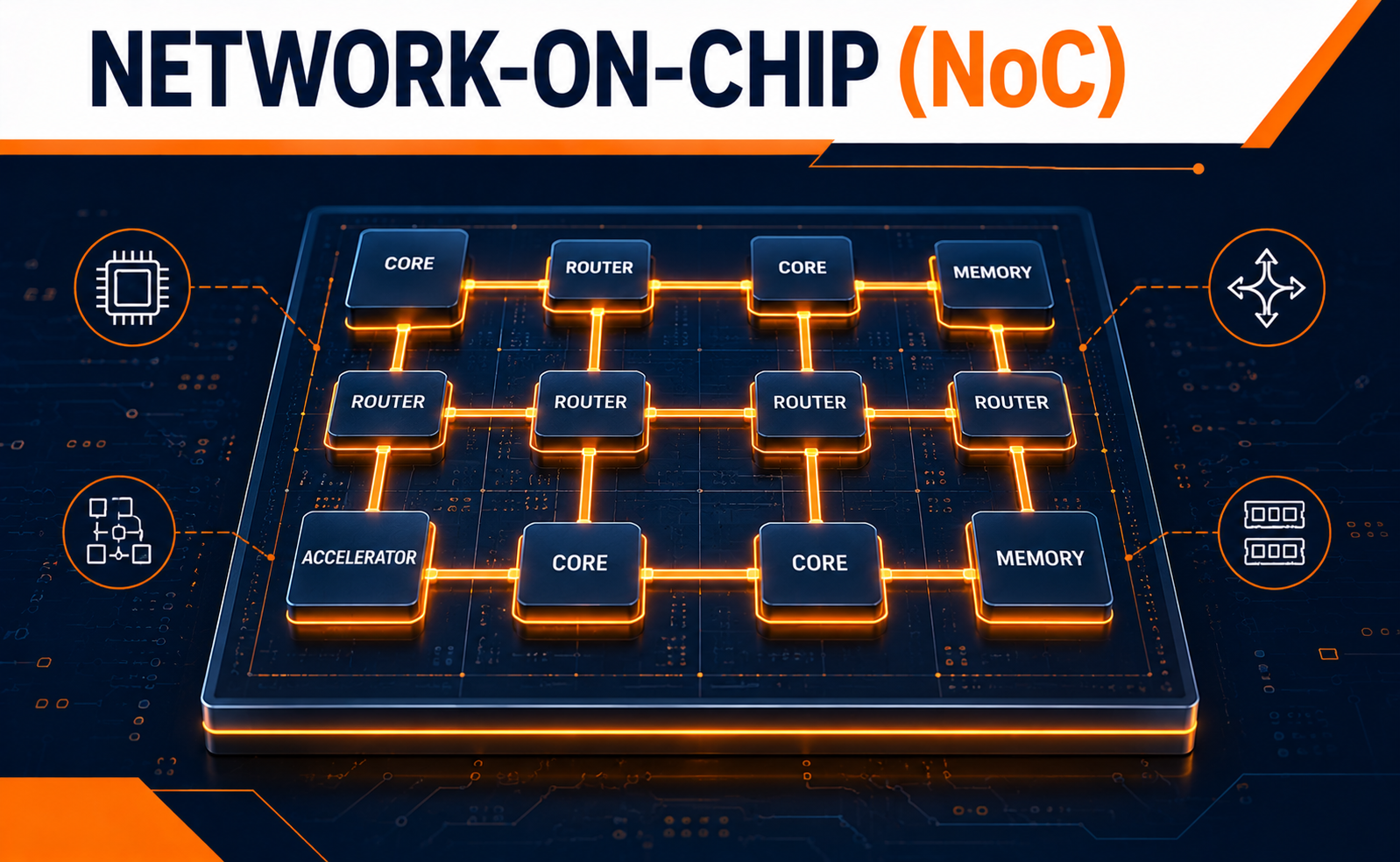
Network-on-Chip (NoC) is an advanced communication architecture that connects multiple intellectual property (IP) cores, processors, memory controllers, and hardware accelerators through an integrated on-chip network.
Instead of relying on a single shared communication bus, NoC uses routers, links, and network protocols to transfer data packets efficiently across the chip.
A typical NoC consists of:
- Processing cores
- On-chip routers
- Communication links
- Network interfaces
- Memory controllers
- Hardware accelerators
This packet-based communication approach significantly improves bandwidth, scalability, and overall system performance.
Why Network-on-Chip is Essential for Modern Chips
As semiconductor devices become increasingly complex, communication efficiency has become one of the biggest design challenges.
Traditional bus architectures often experience:
- Bandwidth limitations
- High communication latency
- Bus contention
- Increased power consumption
- Poor scalability
Network-on-Chip addresses these issues by providing:
- Parallel communication paths
- Higher bandwidth
- Lower latency
- Better scalability
- Improved energy efficiency
- Efficient resource sharing
These advantages make NoC an essential component in advanced semiconductor architectures.
Applications of Network-on-Chip
Network-on-Chip is widely used across today’s most advanced semiconductor products.
System-on-Chip (SoC)
Efficiently connects CPUs, GPUs, DSPs, memory controllers, and peripherals within complex SoCs.
Artificial Intelligence Accelerators
Enables high-speed communication between AI processing engines handling massive parallel workloads.
Multi-Core Processors
Facilitates efficient communication among dozens or hundreds of processor cores.
High-Performance Computing (HPC)
Supports low-latency data movement required for scientific simulations, engineering analysis, and large-scale computing.
Automotive and Embedded Systems
Improves communication reliability in autonomous driving platforms, ADAS systems, industrial automation, and advanced embedded processors.
Advantages
- High communication bandwidth
- Low latency
- Excellent scalability
- Reduced power consumption
- Improved system performance
- Better resource utilization
- Modular architecture
- Support for heterogeneous computing
The Future of Network-on-Chip
As semiconductor devices continue integrating more processing elements, Network-on-Chip will become increasingly important.
Future trends include:
- AI-optimized NoC architectures
- Chiplet-aware communication fabrics
- Integration with 2.5D and 3D semiconductor packaging
- Optical Network-on-Chip (ONoC) technologies
- Machine learning-based adaptive routing
- High-bandwidth interconnects for exascale computing
- Support for next-generation heterogeneous computing platforms
Conclusion
Network-on-Chip has transformed on-chip communication by replacing traditional shared buses with scalable, packet-based networks. This architecture enables modern semiconductor devices to achieve higher bandwidth, lower latency, and improved energy efficiency while supporting increasingly complex chip designs.
Share your question in comments or talk to our mentor team for batch guidance.
Ask the Admin Team
Drop your basic question in comments: eligibility, prerequisites, tools, fee range, and placement support.
Our team reviews and responds regularly.