
For decades, the semiconductor industry relied on Moore’s Law and transistor scaling to deliver higher performance and lower power consumption. However, as technology nodes approach their physical limits, simply shrinking transistors is no longer sufficient to meet the growing demands of artificial intelligence (AI), high-performance computing (HPC), automotive electronics, and advanced data centers.
System Technology Co-Optimization (STCO) has emerged as a next-generation design methodology that optimizes the entire semiconductor system rather than focusing solely on transistor scaling. By jointly optimizing architecture, chip design, process technology, packaging, memory, interconnects, and software, STCO enables significant improvements in system-level performance, power efficiency, and cost.
What is System Technology Co-Optimization (STCO)?
System Technology Co-Optimization (STCO) is a holistic semiconductor design approach that simultaneously optimizes multiple layers of a computing system to achieve the best overall performance, power, area, and cost (PPAC).
Unlike traditional optimization methods that focus on a single design stage, STCO integrates decisions across the entire semiconductor development flow.
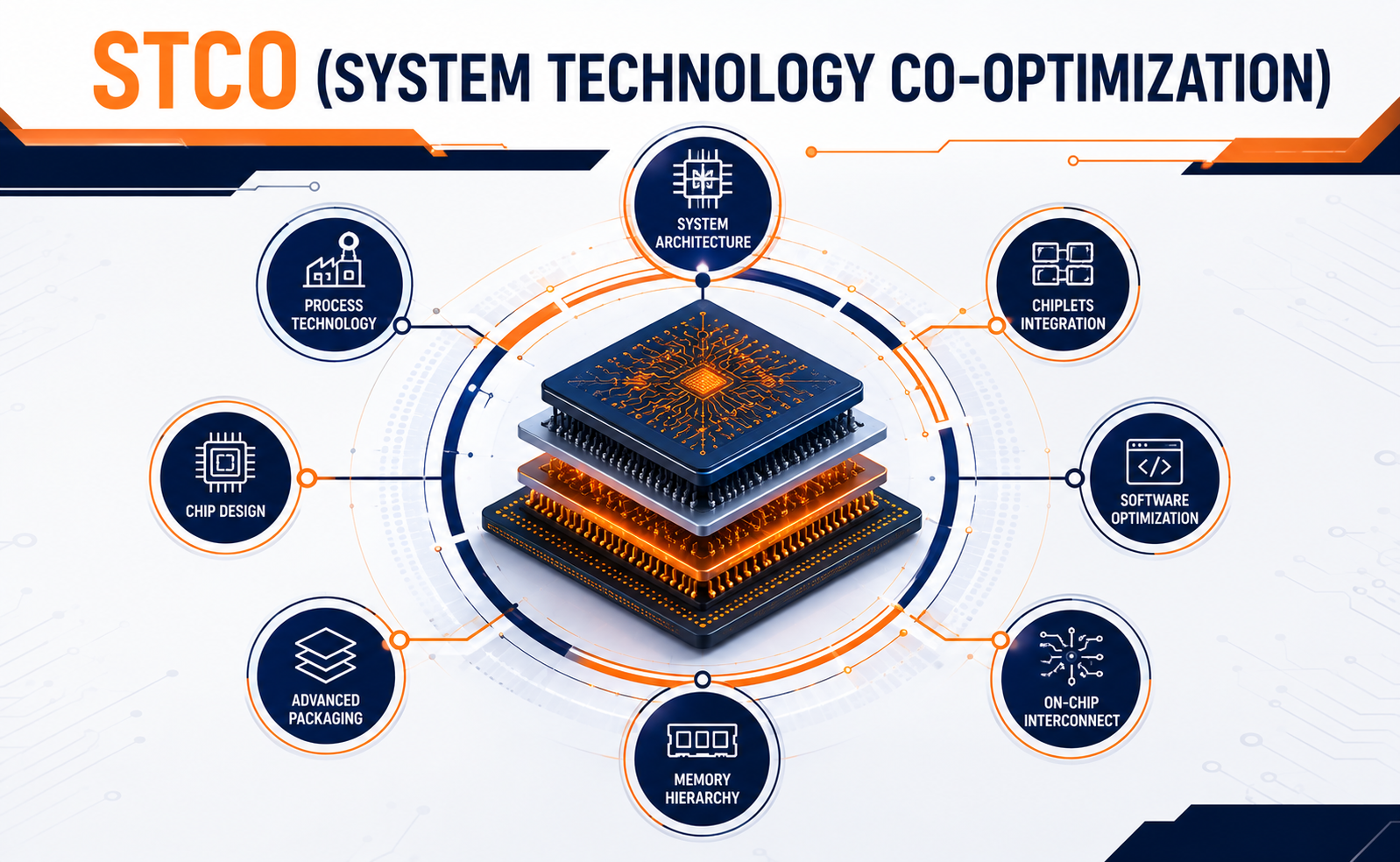
Key domains involved in STCO include:
- System architecture
- Semiconductor process technology
- Chip design
- Advanced packaging
- Memory hierarchy
- On-chip interconnects
- Chiplet integration
- Thermal management
- Software and workload optimization
Why STCO is Essential for Future Semiconductor Development
As transistor scaling slows, system-level optimization has become increasingly important for sustaining performance improvements.
STCO addresses several industry challenges, including:
- Power consumption limitations
- Memory bandwidth bottlenecks
- Increasing design complexity
- Thermal management challenges
- Rising manufacturing costs
- Heterogeneous computing integration
- AI workload optimization
Key Components of STCO
STCO combines multiple semiconductor technologies into a unified optimization strategy.
System Architecture Optimization
Designs processors, accelerators, and memory systems to maximize workload efficiency.
Process Technology Optimization
Selects the most suitable fabrication technologies for different functional blocks, balancing performance and manufacturing cost.
Advanced Packaging
Utilizes technologies such as chiplets, 2.5D integration, 3D packaging, and advanced substrates to improve communication between components.
Memory and Interconnect Optimization
Reduces latency and increases bandwidth through optimized memory hierarchies and high-speed communication fabrics.
Software-Hardware Co-Design
Optimizes software frameworks alongside hardware architecture to improve application-specific performance and energy efficiency.
Applications of STCO
System Technology Co-Optimization is becoming increasingly important across several advanced semiconductor markets.
Artificial Intelligence (AI)
Optimizes AI accelerators, memory subsystems, and interconnect architectures for efficient machine learning workloads.
High-Performance Computing (HPC)
Improves processor scalability, communication efficiency, and energy consumption in supercomputers and scientific computing systems.
Data Centers and Cloud Computing
Enables balanced optimization of compute, networking, memory, and power delivery for hyperscale infrastructure.
Automotive Electronics
Supports advanced driver-assistance systems (ADAS), autonomous driving platforms, and real-time edge computing.
Consumer Electronics
Improves battery life, thermal performance, and computational efficiency in smartphones, tablets, and wearable devices.
The Future of STCO
As semiconductor innovation increasingly shifts from transistor scaling to system-level optimization, STCO is expected to become a fundamental design philosophy for future integrated circuits.
Emerging trends include:
- AI-driven semiconductor design optimization
- Chiplet-based heterogeneous integration
- Advanced 3D packaging technologies
- Silicon photonics integration
- Co-optimization of compute, memory, and networking
- Sustainable semiconductor manufacturing
- Next-generation EDA platforms for automated system optimization
Conclusion
System Technology Co-Optimization (STCO) represents a transformative shift in semiconductor design by moving beyond transistor-centric scaling toward complete system optimization. Through the coordinated development of architecture, fabrication processes, packaging, memory, interconnects, and software, STCO delivers substantial gains in performance, efficiency, and scalability.
Share your question in comments or talk to our mentor team for batch guidance.
Ask the Admin Team
Drop your basic question in comments: eligibility, prerequisites, tools, fee range, and placement support.
Our team reviews and responds regularly.