
As semiconductor devices become more powerful and complex, traditional monolithic chip designs are increasingly being complemented by advanced packaging technologies that combine multiple devices into a single high-performance system. Applications such as artificial intelligence (AI), high-performance computing (HPC), 5G infrastructure, automotive electronics, and data centers require higher bandwidth, lower latency, improved power efficiency, and greater integration density than conventional packaging can provide.
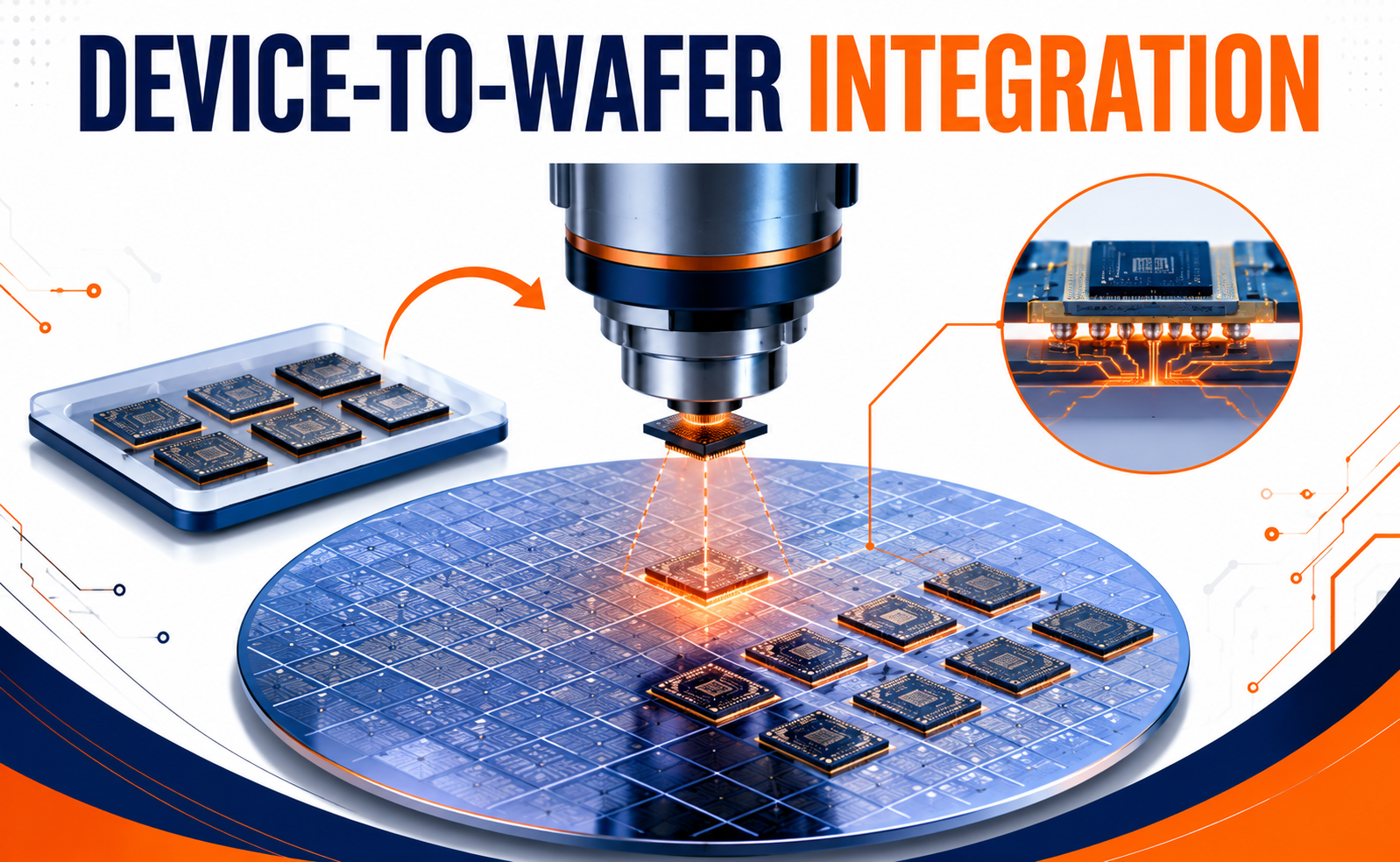
Device-to-Wafer (D2W) Integration is an advanced heterogeneous integration technique in which known-good individual semiconductor dies are precisely placed and bonded onto a fully processed target wafer. This approach allows manufacturers to integrate different process technologies, optimize yield, and reduce manufacturing costs while enabling highly compact, high-performance semiconductor systems.
What is Device-to-Wafer Integration?
Device-to-Wafer Integration is an advanced semiconductor packaging process where individual tested semiconductor dies (known-good dies) are aligned and bonded directly onto a target wafer instead of bonding complete wafers together.
Unlike traditional wafer-to-wafer bonding, D2W integration selectively places only functional devices, significantly improving manufacturing efficiency and overall yield.
Why Device-to-Wafer Integration is Important
Modern semiconductor systems often require combining processors, memory, analog circuits, RF components, sensors, and photonics into a single package.
Device-to-Wafer Integration offers several important advantages:
- Higher manufacturing yield through known-good die selection
- Reduced packaging cost
- Improved bandwidth between integrated devices
- Lower signal latency
- Better power efficiency
- Greater design flexibility
- Integration of multiple semiconductor technologies
- Smaller package size
Applications of Device-to-Wafer Integration
Device-to-Wafer Integration is widely adopted across advanced semiconductor applications.
Artificial Intelligence Processors
Integrates compute dies, high-bandwidth memory (HBM), and accelerator chips into compact AI systems.
High-Performance Computing (HPC)
Supports multi-chip architectures with ultra-high interconnect bandwidth and reduced communication latency.
Chiplet-Based Architectures
Combines separately manufactured chiplets into a single advanced semiconductor package.
Advanced Memory Systems
Enables high-density memory integration for servers, networking equipment, and AI accelerators.
Photonics and Heterogeneous Systems
Integrates silicon photonics, RF devices, MEMS sensors, and analog circuits with digital logic on a common platform.
The Future of Device-to-Wafer Integration
As semiconductor technology moves beyond traditional scaling, Device-to-Wafer Integration is expected to become a cornerstone of advanced packaging.
Future developments include:
- Hybrid bonding with sub-micron interconnect pitch
- AI-assisted die placement optimization
- Larger chiplet ecosystems
- Integration with glass substrates
- Advanced optical interconnects
- 3D heterogeneous integration
- Improved thermal management materials
- Fully automated intelligent packaging lines
Conclusion
Device-to-Wafer Integration is transforming semiconductor packaging by enabling the precise integration of known-good dies onto fully processed wafers. Its ability to improve yield, reduce costs, and combine multiple semiconductor technologies makes it one of the most important packaging innovations for modern electronics.
As demand continues to grow for AI, high-performance computing, automotive electronics, and next-generation communication systems, Device-to-Wafer Integration will play a central role in delivering faster, smaller, and more efficient semiconductor solutions that define the future of the industry.
Share your question in comments or talk to our mentor team for batch guidance.
Ask the Admin Team
Drop your basic question in comments: eligibility, prerequisites, tools, fee range, and placement support.
Our team reviews and responds regularly.