

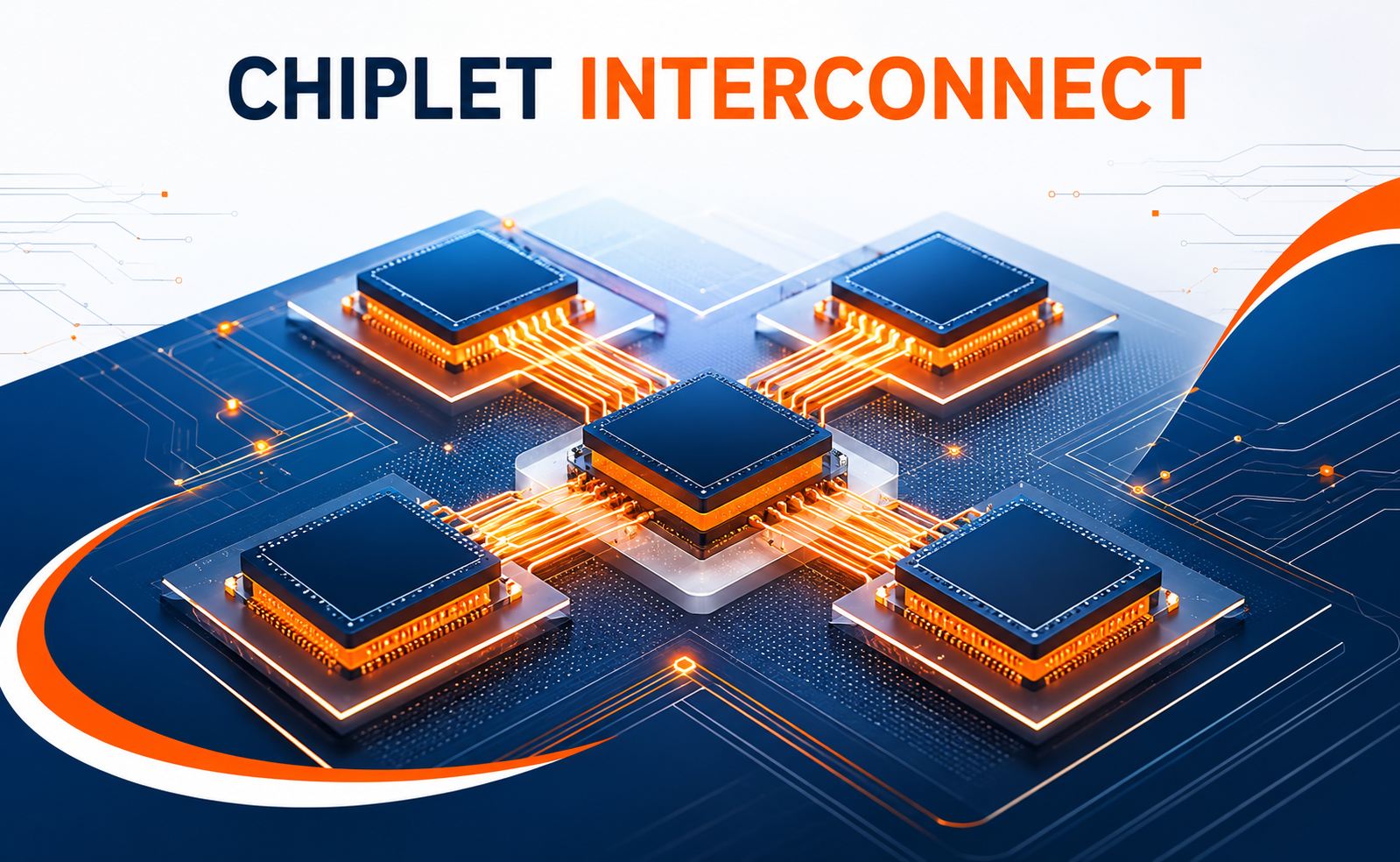
As semiconductor designs become increasingly complex, traditional monolithic chips are facing challenges in scalability, manufacturing cost, power efficiency, and design flexibility. Chiplet technology addresses these challenges by dividing a large system into smaller, specialized dies that can be integrated into a single package.
At the heart of this approach is chiplet interconnect technology. It provides the high-speed communication pathways that allow individual chiplets to exchange data, power, and control information efficiently. A well-designed interconnect is essential for achieving the performance benefits promised by chiplet-based architectures.
What Is Chiplet Interconnect?
Chiplet interconnect refers to the physical and logical connections that enable multiple chiplets within an advanced package to communicate with one another.
Unlike conventional board-level communication, chiplet interconnects operate over extremely short distances inside a package. This enables significantly higher bandwidth and lower latency while reducing some of the energy overhead associated with moving data between separate packages.
These connections can be implemented through technologies such as advanced substrate routing, silicon interposers, bridges, and direct die-to-die connections. The choice depends on factors such as bandwidth requirements, package architecture, power targets, cost, and manufacturing capabilities.
Key Technologies Behind Chiplet Interconnect
Several technologies are helping advance chiplet-to-chiplet communication.
Die-to-die interfaces provide standardized or proprietary communication channels between chiplets. Industry initiatives such as UCIe (Universal Chiplet Interconnect Express) are working toward interoperable chiplet ecosystems by defining common standards for die-to-die communication.
2.5D integration uses an interposer or advanced substrate to connect multiple chiplets with dense wiring. This approach can provide high bandwidth while allowing different chiplets to be manufactured using different process technologies.
3D integration takes interconnect density even further by stacking dies vertically. Technologies such as hybrid bonding can create very short, dense connections between vertically integrated components, supporting high data-transfer rates and improved system-level integration.
Why Chiplet Interconnect Matters
The interconnect can have a major influence on the overall performance of a chiplet-based system. High-bandwidth and low-latency communication allows processing, memory, accelerator, and I/O chiplets to work together more efficiently.
Another important advantage is design flexibility. Different chiplets can be developed using the process technology best suited to their function. For example, a high-performance compute chiplet may use an advanced process node, while an I/O or analog chiplet may use a more mature and cost-effective technology.
Chiplet interconnects can also improve scalability by making it easier to combine multiple processing resources within a single package.
The Future of Chiplet Interconnect
Chiplet interconnect technology is expected to become increasingly important as semiconductor systems move toward heterogeneous and highly integrated architectures.
Future developments are likely to focus on higher bandwidth, lower energy-per-bit, greater interoperability, advanced 3D integration, improved thermal solutions, and more sophisticated packaging technologies.
As standards mature and chiplet ecosystems expand, designers will have greater freedom to combine specialized compute, memory, networking, AI acceleration, and I/O chiplets into customized systems.
Ultimately, chiplet interconnect is more than a connection between dies—it is a critical foundation for building the scalable, modular, and high-performance semiconductor architectures of the future.
Share your question in comments or talk to our mentor team for batch guidance.
Ask the Admin Team
Drop your basic question in comments: eligibility, prerequisites, tools, fee range, and placement support.
Our team reviews and responds regularly.