

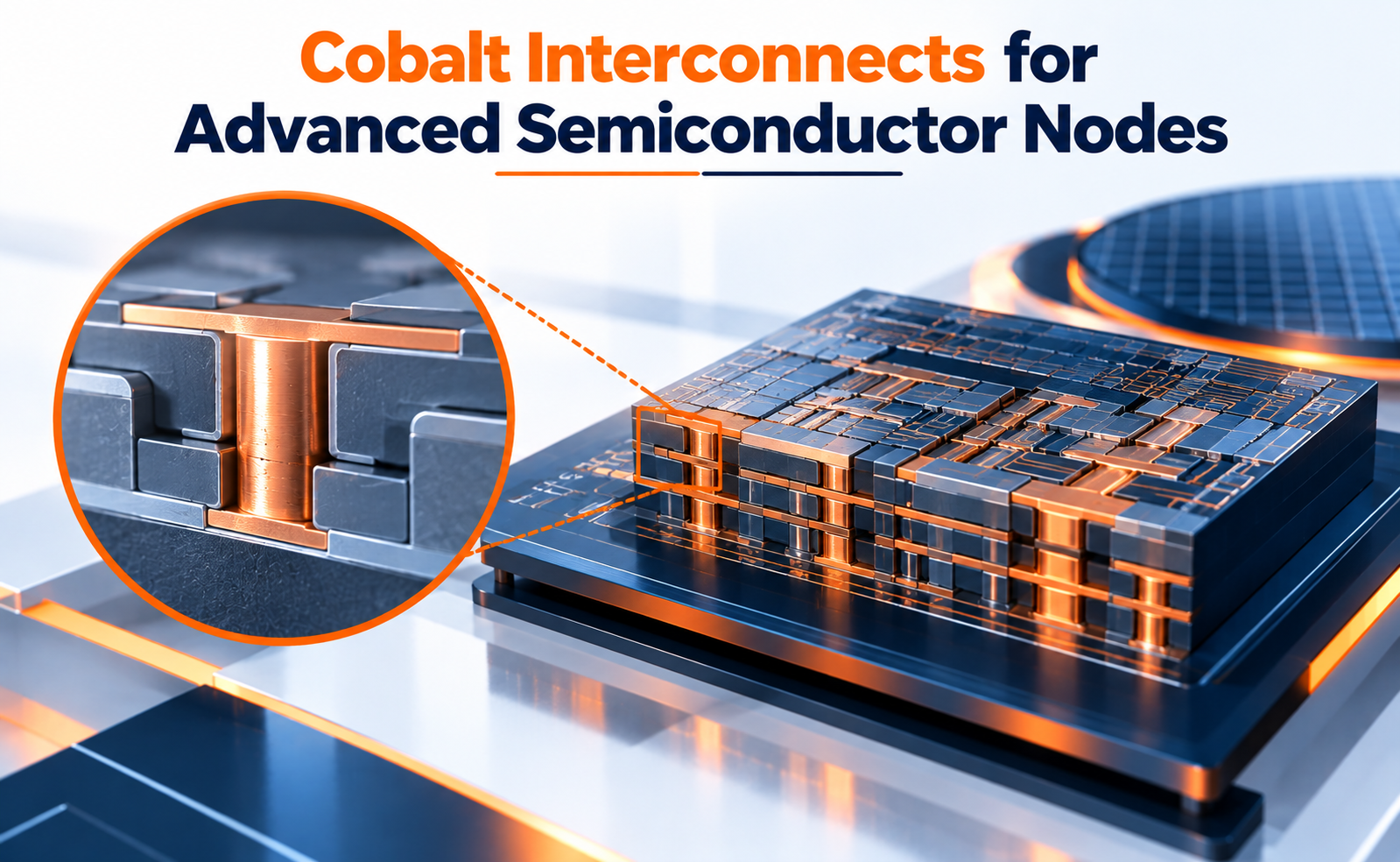
As semiconductor technology continues to scale, traditional interconnect materials face increasing challenges from rising resistance, electromigration, and shrinking dimensions. At advanced technology nodes, the interconnect structure becomes just as important as the transistor in determining overall chip performance.
Cobalt (Co) interconnects have emerged as an important materials solution for selected advanced semiconductor interconnect applications. With favorable properties at very small dimensions, cobalt can help address some of the challenges associated with continued interconnect scaling.
What Are Cobalt Interconnects?
Cobalt interconnects are metal wiring structures that use cobalt as the conductive material within the semiconductor’s back-end-of-line (BEOL) interconnect stack.
Traditionally, copper has been the dominant material for many semiconductor interconnect layers because of its excellent electrical conductivity. However, as dimensions shrink, factors such as barrier-layer thickness, surface scattering, and electromigration become increasingly significant.
Cobalt offers different material characteristics that can become advantageous at very small feature sizes, particularly in applications involving narrow interconnects, vias, contacts, and local wiring.
A simplified interconnect structure can be viewed as:
Transistor → Contact → Local Interconnect → Via → Metal Layer
Cobalt may be introduced into specific portions of this structure where its scaling characteristics provide a potential performance or reliability advantage.
Why Is Cobalt Important at Advanced Nodes?
As metal dimensions approach the nanoscale, simply shrinking conventional copper wiring does not guarantee improved performance.
Several effects become increasingly important:
- Higher electrical resistance
- Increased electron scattering
- Electromigration concerns
- Barrier and liner thickness
- Reduced effective conductive cross-section
- Greater sensitivity to process variation
Cobalt can be attractive because it can perform well in certain very small interconnect structures, where conventional copper architectures may lose some of their advantages.
The goal is not necessarily to replace copper everywhere. Instead, advanced semiconductor processes can use different metals at different interconnect levels, selecting the material that best matches the dimensions and performance requirements of each layer.
Key Advantages of Cobalt Interconnects
Cobalt provides several characteristics that can make it attractive for advanced-node interconnect structures.
Improved Scaling at Small Dimensions
Cobalt can offer favorable performance in certain narrow features where conventional copper structures become increasingly affected by scaling-related limitations.
Electromigration Performance
Cobalt can provide strong electromigration resistance in appropriate interconnect configurations, supporting long-term reliability.
Potentially Reduced Barrier Impact
In some integration schemes, cobalt can enable thinner interface or barrier structures, increasing the fraction of the feature available for electrical conduction.
Local Interconnect Applications
Cobalt is particularly relevant to small contacts and local interconnect structures where dimensions are extremely constrained.
Advanced Process Flexibility
Using cobalt alongside copper allows semiconductor manufacturers to optimize different interconnect levels according to their electrical, dimensional, and reliability requirements.
The Future of Cobalt Interconnects
As semiconductor nodes continue to advance, interconnect scaling will increasingly depend on materials innovation and architectural optimization, not simply smaller lithographic dimensions.
Future developments are likely to focus on:
- Ultra-small cobalt contacts and vias
- Improved deposition and gap-fill processes
- Advanced liner and barrier engineering
- Reduced interconnect resistance
- Improved electromigration reliability
- Better surface and interface control
- Integration of cobalt with copper-based wiring
- Advanced metrology and defect inspection
Cobalt is therefore best viewed as part of a broader multi-material interconnect strategy, where copper, cobalt, and potentially other conductive materials are used selectively according to the requirements of different interconnect levels.
Conclusion
Cobalt interconnects are an important materials innovation for advanced semiconductor nodes. As interconnect dimensions continue to shrink, the electrical and reliability limitations of conventional materials become more difficult to manage.
By leveraging cobalt in carefully selected contacts, vias, and local interconnect structures, semiconductor manufacturers can address some of the challenges associated with nanoscale wiring while maintaining compatibility with broader copper-based interconnect architectures.
Ultimately, the future of semiconductor scaling will depend not only on smaller transistors, but also on better materials, precise process integration, and advanced interconnect engineering—with cobalt playing an important role in this evolution.
Share your question in comments or talk to our mentor team for batch guidance.
Ask the Admin Team
Drop your basic question in comments: eligibility, prerequisites, tools, fee range, and placement support.
Our team reviews and responds regularly.