

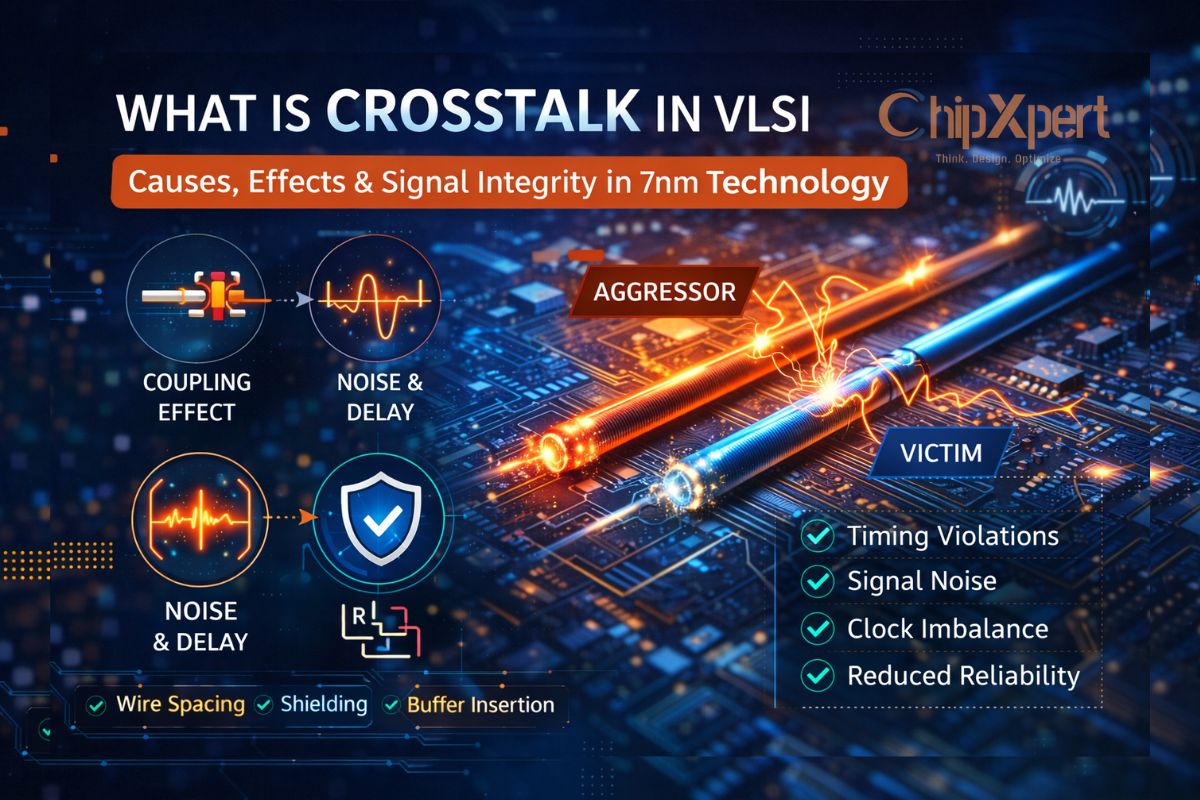
As semiconductor technology advances into smaller nodes such as 7nm and below, signal integrity challenges become increasingly critical. One of the most significant issues designers face in modern chip design is crosstalk. While it may appear as a small electrical interference at first glance, crosstalk can affect timing, reliability, and overall chip performance.
For VLSI engineers working in physical design or timing analysis, understanding crosstalk is essential. In this article, we explore what crosstalk means in integrated circuits, why it becomes more serious in advanced technology nodes, and how engineers reduce its impact.
Understanding Crosstalk in VLSI
In VLSI circuits, crosstalk refers to unwanted interference between adjacent signal wires or nets. When a signal switches on one wire, it can influence the electrical behavior of a nearby wire due to coupling effects.
This interaction happens because closely spaced interconnects share capacitive or inductive coupling, allowing energy from one signal line to affect another.
In simple terms, a signal traveling through one wire can unintentionally disturb the signal in a neighboring wire.
Within this interaction, two nets are usually defined:
- Aggressor Net – the signal line causing the disturbance
- Victim Net – the signal line being affected by the disturbance
Understanding this aggressor–victim relationship is key to analyzing crosstalk in chip design.
Why Crosstalk Happens
Crosstalk mainly occurs because of coupling capacitance between nearby wires. When two interconnects run close together for a long distance, their electric fields interact, creating parasitic capacitance between them.
Several factors increase the likelihood of crosstalk:
- Long parallel routing of signal wires
- Small spacing between interconnects
- High switching activity in aggressor nets
- High operating frequencies
As chip designs become denser and faster, these factors become more common, increasing the risk of signal interference.
Types of Crosstalk Effects
Crosstalk in VLSI typically appears in two main forms.
Crosstalk Noise
Crosstalk noise occurs when a switching aggressor signal induces a temporary voltage spike on a nearby victim net. This can create a glitch or unwanted pulse on the victim signal.
If the noise is large enough, it may cause the logic value of the victim signal to change incorrectly, leading to functional errors.
Crosstalk Delay
Crosstalk can also affect the timing of signals. When aggressor and victim nets switch simultaneously, the victim signal may either speed up or slow down depending on the direction of switching.
This phenomenon is known as crosstalk delay, and it can cause timing problems such as setup or hold violations during static timing analysis.
Why Crosstalk Is More Critical at 7nm
In older technology nodes, crosstalk existed but was relatively manageable. However, at 7nm technology and beyond, several design changes make crosstalk more severe.
Smaller Interconnect Spacing
Advanced nodes pack more wires into a smaller area. Reduced spacing increases coupling capacitance between neighboring wires, which directly increases crosstalk.
Higher Switching Speeds
Modern processors and AI chips operate at extremely high clock frequencies. Faster switching signals generate stronger electrical interactions between nearby nets.
Lower Voltage Levels
As power consumption becomes a major concern, supply voltages are reduced in advanced nodes. Lower voltage margins make circuits more sensitive to noise disturbances.
Higher Design Density
The number of transistors and interconnects in modern chips continues to grow rapidly. This high density increases the probability of long parallel routing paths, which further amplifies crosstalk effects.
Because of these factors, managing crosstalk is now a major part of signal integrity analysis in advanced semiconductor nodes.
Impact of Crosstalk on Chip Performance
If not handled properly, crosstalk can create serious issues in chip functionality and performance.
Timing Violations
Crosstalk delay can alter the arrival time of signals. This may cause setup or hold violations, especially in high-speed designs.
Signal Integrity Problems
Noise spikes caused by crosstalk can distort signals, leading to incorrect logic values.
Clock Tree Imbalance
Clock networks are particularly sensitive to interference. Crosstalk can disturb the balance of clock distribution, affecting synchronization across the chip.
Reduced Reliability
Repeated noise disturbances and timing instability may reduce long-term reliability of the device.
Techniques to Reduce Crosstalk in VLSI
Physical design engineers apply several techniques to minimize crosstalk during chip layout and routing.
Increasing Wire Spacing
One of the simplest solutions is increasing the spacing between aggressor and victim nets. Greater separation reduces coupling capacitance.
Shielding
A grounded wire or power net can be placed between two critical signal lines. This acts as a shield that absorbs interference.
Layer Assignment Optimization
Signals can be routed on different metal layers to reduce parallel coupling.
Buffer Insertion
Buffers can break long nets into smaller segments, reducing coupling effects.
Driver Strength Adjustment
Reducing aggressor switching strength or strengthening the victim driver can reduce the influence of crosstalk.
Modern EDA tools also include crosstalk analysis and noise-aware timing analysis to detect and fix violations during the design stage.
Crosstalk Analysis in Modern Physical Design
In advanced nodes like 7nm, crosstalk is analyzed during multiple stages of the physical design flow.
Key analysis steps include:
- Signal integrity checks
- Static timing analysis with coupling effects
- Post-routing noise verification
Design tools simulate switching behavior of neighboring nets to estimate worst-case interference scenarios.
This ensures that the chip remains reliable under real operating conditions.
Conclusion
Crosstalk is a critical signal integrity challenge in VLSI physical design, especially as semiconductor technology scales to advanced nodes such as 7nm. It occurs when signals on adjacent wires interact through capacitive or inductive coupling, potentially causing noise, delay, and timing violations.
With increasing circuit density and higher operating speeds, managing crosstalk has become a key responsibility for physical design engineers. By applying proper routing strategies, shielding techniques, and signal integrity analysis, designers can minimize interference and ensure reliable chip performance.
Understanding and controlling crosstalk is essential for building high-performance, manufacturable integrated circuits in modern semiconductor technology.
Share your question in comments or talk to our mentor team for batch guidance.
Need Fee, Duration, or Demo Class Details?
Talk to our admin team for the latest batch plan and career guidance.
Contact Admin TeamAsk the Admin Team
Drop your basic question in comments: eligibility, prerequisites, tools, fee range, and placement support.
Our team reviews and responds regularly.