

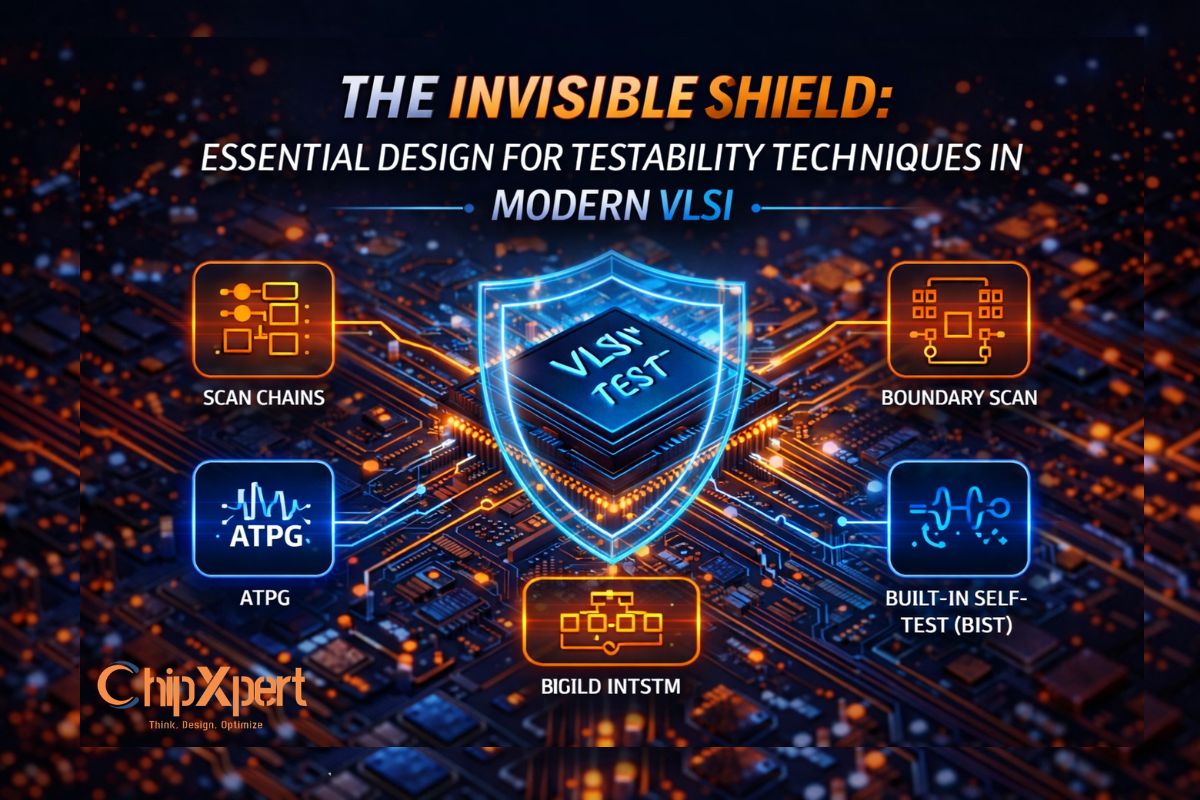
In the fast-paced semiconductor world of 2026, we often celebrate the “Power, Performance, and Area” (PPA) of a new 2nm chip. However, there is a fourth, equally critical pillar that often remains behind the scenes: Design for Testability (DFT).
As chips become more complex, with billions of transistors and microscopic interconnects, the probability of a physical defect during manufacturing increases. A tiny particle of dust or a slight variation in the etching process can result in a “dead” chip. Without DFT, identifying which chips are healthy and which are faulty would be like finding a needle in a haystack. DFT is the specialized engineering discipline of adding extra “test logic” to the chip so we can verify its internal health in a matter of seconds.
1. Scan Design and Scan Chain Insertion
The most fundamental technique in the DFT toolkit is Scan Design. In a standard digital design, the internal flip-flops are difficult to access from the external pins. Scan design solves this by replacing standard flip-flops with “Scan Flip-Flops.”
During the test mode, these flip-flops are linked together to form a long shift register called a Scan Chain. This allows a test engineer to “shift in” a specific pattern of 1s and 0s to set the internal state of the chip, execute one clock cycle of functional logic, and then “shift out” the result to check for errors. This technique provides the observability and controllability needed to catch structural defects like “stuck-at” faults.
2. Built-In Self-Test (BIST)
As we move toward 2026, chips are increasingly being used in safety-critical applications like autonomous vehicles and medical devices. These chips need to be tested not just at the factory, but every time they power up. This is where Built-In Self-Test (BIST) comes in.
BIST involves adding an on-chip “tester” that includes a pattern generator and a signature analyzer.
- Memory BIST (MBIST): Specialized logic that runs complex algorithms (like March tests) to check for defects in high-density SRAM and DRAM banks.
- Logic BIST (LBIST): Uses pseudo-random patterns to test the functional logic gates without needing an external Automated Test Equipment (ATE) machine.
BIST is the key to “field reliability,” allowing a car to verify that its braking controller is 100% functional before you even shift out of park.
3. Boundary Scan and JTAG (IEEE 1149.1)
Once a chip is soldered onto a Printed Circuit Board (PCB), it becomes very difficult to test its pins using physical probes. Boundary Scan, commonly known by the JTAG standard, was created to solve this “board-level” test challenge.
Boundary scan adds a shift register cell to every single pin of the chip. By linking these cells together, we can “virtualize” the pins. This allows us to test the connections between different chips on a board without ever touching them physically. In 2026, JTAG has also evolved into a primary interface for debugging software and programming on-chip flash memory.
4. Automatic Test Pattern Generation (ATPG)
DFT is not just about hardware; it is also about the software algorithms that drive the hardware. Automatic Test Pattern Generation (ATPG) is the process of using sophisticated EDA tools to mathematically determine the minimum number of test patterns required to achieve maximum “fault coverage.”
In a 2026 SoC, running a complete test can involve millions of patterns. ATPG tools optimize these patterns to reduce “test time,” which is a direct driver of the final product cost. The higher the fault coverage (typically 99% or higher for stuck-at faults), the lower the chances of a “Test Escape,” where a faulty chip accidentally reaches a customer.
5. Compression Techniques
With the explosion of transistor counts, the amount of test data required has outpaced the memory capacity of standard ATE machines. To solve this, DFT engineers use Test Data Compression.
Compression logic on the chip acts like a “Zip” file extractor. It takes a small, compressed stream of data from the tester, expands it into thousands of scan chains internally, and then compresses the results back for the tester to verify. This allows us to test massive 2nm AI processors using relatively simple and inexpensive testing equipment.
Conclusion: Engineering for Perfection
Design for Testability is the ultimate bridge between the “ideal” world of digital design and the “imperfect” world of physical manufacturing. By integrating scan chains, BIST, and JTAG, we ensure that the complex silicon we design can be verified with absolute certainty.
For the next generation of engineers, DFT is a field that combines hardware design, algorithmic thinking, and statistical analysis. It is the discipline that ensures that when a consumer presses the “on” button, the billions of transistors inside their device work exactly as intended. In the high-stakes era of 2026, DFT is no longer an afterthought; it is the silent guardian of silicon quality and the foundation of global technological trust.
Share your question in comments or talk to our mentor team for batch guidance.
Need Fee, Duration, or Demo Class Details?
Talk to our admin team for the latest batch plan and career guidance.
Contact Admin TeamAsk the Admin Team
Drop your basic question in comments: eligibility, prerequisites, tools, fee range, and placement support.
Our team reviews and responds regularly.