

In VLSI design, every detail counts when it comes to achieving functionality, performance, and manufacturability. One element that often goes unnoticed by beginners but plays an important role in physical design is the end cap cell.
End cap cells help ensure that standard cells in a digital design sit correctly at the boundaries of rows and blocks. Without them, timing, power distribution, and signal integrity can be negatively affected. In this article, we will explain what end cap cells are, why they are used, and how they contribute to successful chip implementation.
What Are End Cap Cells
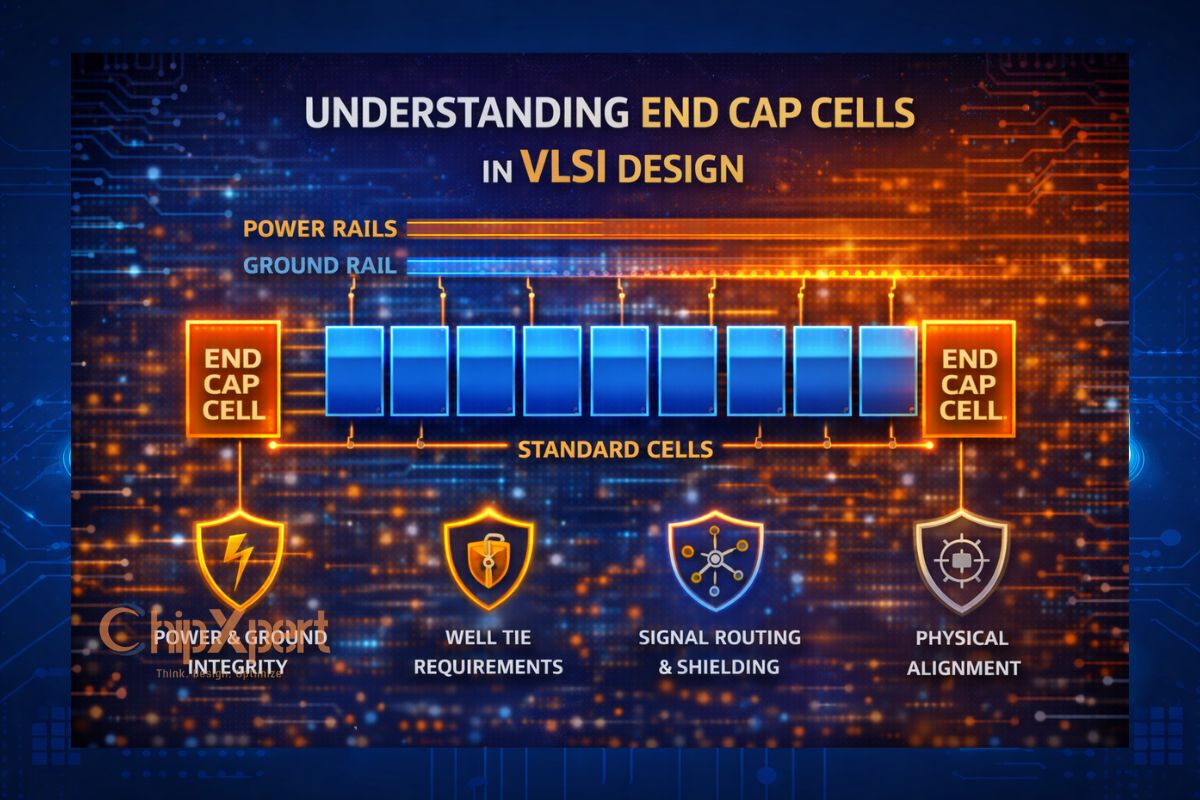
End cap cells are special types of cells placed at the beginning and end of a row of standard cells during physical design. When standard cells are arranged in rows during floorplanning and placement, the first and last cells in each row connect to power rails and well structures differently than cells in the middle.
An end cap cell ensures that the connections to power rails, ground rails, and well ties are properly terminated. These cells do not contain functional logic, but they provide the necessary electrical and physical closure for a row of cells.
Why End Cap Cells Are Required
During physical design, rows of standard cells are created with specific spacing and alignment to meet routing and power requirements. Standard cells are designed to share power rails and substrate connections with neighboring cells. However, at the edges of a row, there is no neighbor on one side.
Without proper closure, several issues can arise:
Power and Ground Integrity
Standard cells rely on shared power and ground connections in a row. At the edges, if there is no end cap, the power and ground rails may not be connected as expected. This can lead to open circuits or irregular voltage distribution.
End cap cells provide the necessary connections to ensure that power and ground nets are correctly terminated at row boundaries.
Well Tie Requirements
Transistor wells and substrate connections must be properly tied to prevent electrical leakage and noise. End cap cells include well tie structures that connect wells at the row boundary to proper reference potentials.
Signal Routing and Shielding
Without end caps, neighboring rows may be forced to route signals near the row edge, creating congestion or potential crosstalk. End cap cells help to maintain consistent routing channels and signal integrity.
Physical Alignment
Physical design tools expect rows of cells to have consistent boundaries. End cap cells provide the required boundary markers that help placement tools maintain proper alignment.
How End Cap Cells Are Designed
End cap cells are specially crafted to fit the height, power rail alignment, and placement constraints of the standard cell library used in a design. They must match exactly the row height and power rail positions of the other cells in the row so that they do not disrupt the consistency of the layout.
Typically, end cap cells include:
- Power and ground pin structures
- Well ties for substrate and well biasing
- Fill structures to maintain density requirements
- Reserved space for routing continuity
End cap cell design does not involve logic gates or combinational logic. Their purpose is purely structural and electrical support.
End Cap Placement Rules
In a typical digital design flow, placement tools automatically insert end cap cells based on design rules. However, certain guidelines must be followed to ensure correct usage:
Row Alignment
End cap cells must align precisely with the row height and power rail positions. A mismatch can lead to routing failures or power integrity problems.
Consistent Spacing
Standard cell rows must maintain consistent spacing between cells and rails. End cap cells ensure that this spacing remains uniform at boundaries.
Power Net Continuity
End cap cells must connect to the correct power and ground nets, ensuring continuity across rows. This is particularly important when multiple voltage domains are present.
Library Support
The standard cell library must include end cap variants compatible with all row heights and rail positions used in the design. A missing end cap cell in a library can create placement errors.
End Caps and Routing
By marking the boundaries of rows and providing well-defined electrical connections, end cap cells help simplify routing. Placement tools can make reliable assumptions about where routing tracks begin and end.
End cap cells also help tools maintain consistent track assignments for signal nets, power, and clocks. In high performance designs, clock routing is especially sensitive to physical boundaries. Proper end caps help ensure balanced clock tree distribution without unexpected obstacles near row edges.
Impact on Power, Performance, and Area
Although end cap cells do not contain logic, they still contribute to the physical and electrical quality of the design:
Power Distribution
As termination points for power and ground rails, end cap cells help ensure that every cell in the row gets a reliable supply. This improves voltage uniformity and reduces IR drop issues.
Signal Integrity
By resisting unexpected routing shortcuts near row edges, end cap cells reduce the risk of crosstalk and noise coupling that could affect performance.
Effective Area Utilization
End cap cells occupy space at row edges. Although they do not perform logic functions, their presence ensures that usable cell rows are properly terminated. This can improve overall placement stability without sacrificing design quality.
Conclusion
End cap cells are structural elements in VLSI physical design that ensure correct power, ground, and well connections at row boundaries. While they do not participate in logic operations, their proper placement and design help ensure stable power distribution, correct routing, and predictable placement behavior.
Understanding end cap cells is essential for engineers working in physical design and layout, as these small but essential elements contribute significantly to the successful implementation of digital chips.
Share your question in comments or talk to our mentor team for batch guidance.
Need Fee, Duration, or Demo Class Details?
Talk to our admin team for the latest batch plan and career guidance.
Contact Admin TeamAsk the Admin Team
Drop your basic question in comments: eligibility, prerequisites, tools, fee range, and placement support.
Our team reviews and responds regularly.