

Every semiconductor chip begins with a carefully engineered fabrication process that transforms a blank silicon wafer into billions of functional transistors. This critical phase, known as Front-End-of-Line (FEOL), forms the active devices that serve as the computational core of integrated circuits.
As semiconductor technology advances toward smaller process nodes and more complex transistor architectures, FEOL has become increasingly sophisticated. It encompasses the formation of transistors, wells, isolation structures, and gate stacks that determine the performance, power efficiency, and reliability of modern chips. From smartphones and AI processors to automotive electronics and high-performance computing systems, every advanced semiconductor relies on a precisely executed FEOL process.
What is Front-End-of-Line (FEOL)?
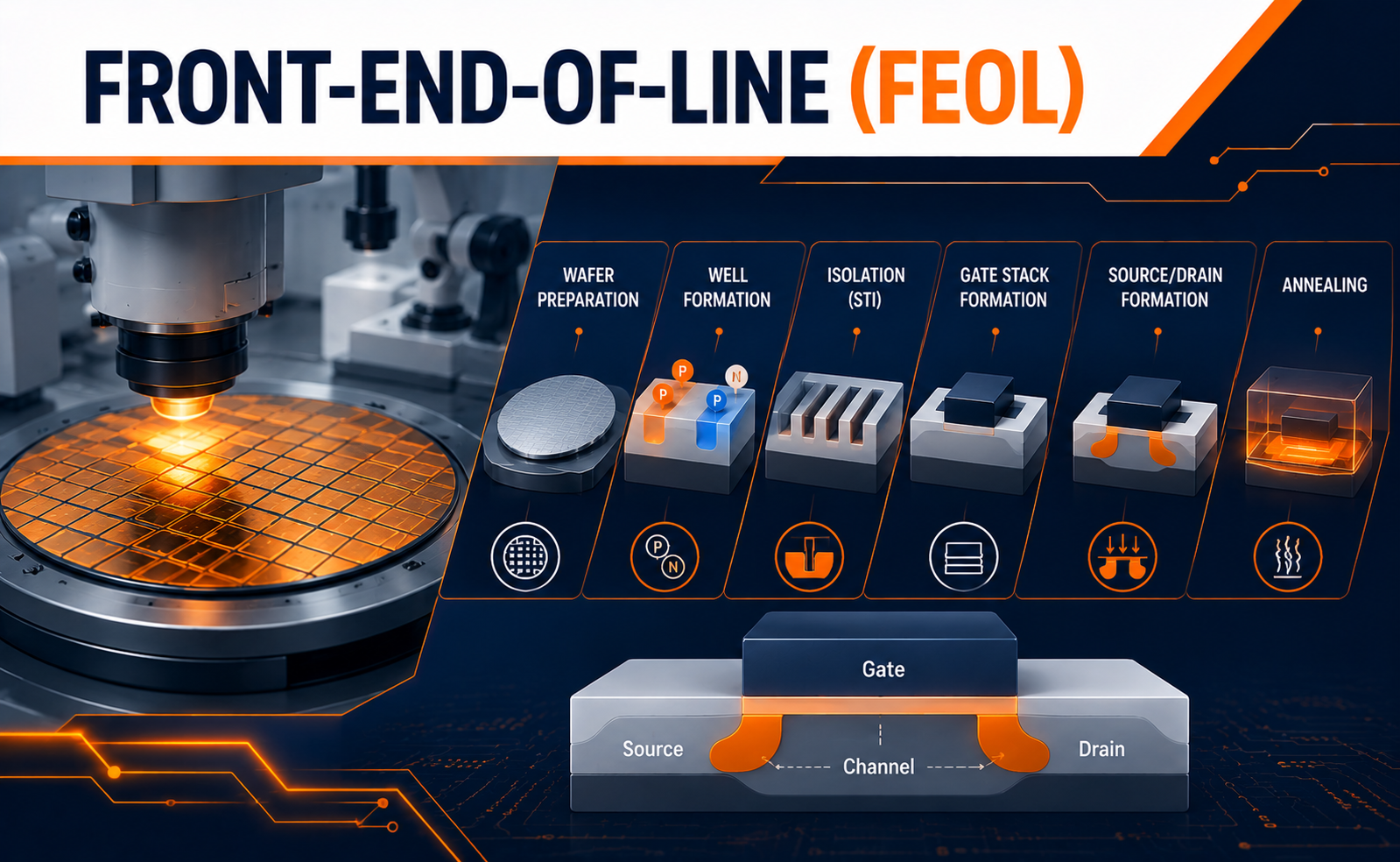
Front-End-of-Line (FEOL) is the initial phase of semiconductor wafer fabrication where the active electronic devices are created on a silicon wafer. During this stage, manufacturers build the transistor structures that will later be interconnected to form complete integrated circuits.
The FEOL process includes several essential fabrication steps, such as:
- Silicon wafer preparation
- Well formation
- Isolation structures
- Gate oxide formation
- Gate electrode fabrication
- Source and drain implantation
- Dopant activation through annealing
Why FEOL is Critical in Semiconductor Manufacturing
The quality of the FEOL process directly determines the electrical performance and reliability of the finished chip.
A well-optimized FEOL process provides:
- Higher transistor performance
- Lower leakage current
- Improved switching speed
- Better power efficiency
- Higher manufacturing yield
- Enhanced device reliability
- Consistent transistor characteristics across the wafer
Advanced FEOL Technologies
Modern semiconductor manufacturing incorporates several advanced technologies during FEOL to support next-generation transistor architectures.
FinFET Fabrication
FEOL processes create the three-dimensional fin structures required for FinFET transistors, improving electrostatic control and reducing leakage.
Gate-All-Around (GAA) Transistors
Advanced FEOL techniques enable the fabrication of nanosheet and nanowire channels used in GAA transistor architectures for future technology nodes.
High-k Metal Gate (HKMG)
High-k dielectric materials combined with metal gates reduce leakage current while improving transistor performance and power efficiency.
Advanced Ion Implantation
Precision implantation techniques ensure accurate dopant placement for nanoscale transistor dimensions.
The Future of FEOL Technology
The evolution of FEOL will continue to shape the future of semiconductor innovation as manufacturers develop increasingly advanced transistor architectures.
Emerging trends include:
- Sub-2nm semiconductor fabrication
- Complementary FET (CFET) architectures
- Advanced Gate-All-Around transistor manufacturing
- High-NA EUV lithography integration
- Atomic Layer Deposition (ALD) and Atomic Layer Etching (ALE)
- AI-driven process optimization and defect detection
- New semiconductor materials beyond silicon
Conclusion
Front-End-of-Line (FEOL) is the foundation of semiconductor manufacturing, where the active transistors that power modern electronics are created. Every improvement in FEOL directly impacts chip performance, energy efficiency, reliability, and scalability.
Share your question in comments or talk to our mentor team for batch guidance.
Ask the Admin Team
Drop your basic question in comments: eligibility, prerequisites, tools, fee range, and placement support.
Our team reviews and responds regularly.