

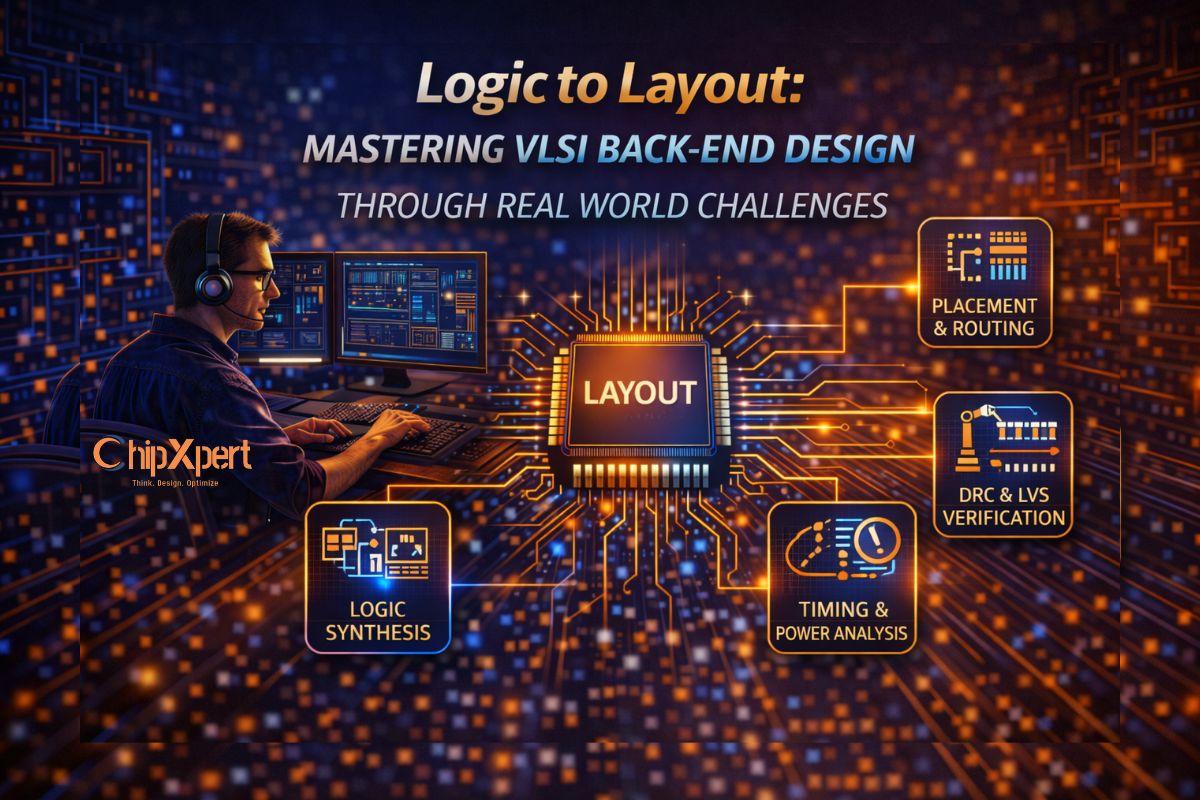
The Architecture of Reality
In the VLSI world, the “Front-End” is often seen as the realm of ideas. It is where architects and designers write code in SystemVerilog to define the behavior of a chip. But the “Back-End,” also known as Physical Design, is where those ideas meet the uncompromising laws of physics. It is the journey of turning a logical netlist into a physical map of billions of transistors and miles of microscopic wiring.
As we navigate the 2026 design landscape, the transition from logic to layout has become the most difficult part of the chip-making process. At 2nm and below, the wires are so thin that they behave like resistors, and the gates are so small that they leak energy. Mastering the back-end is no longer about just “running the tools”; it is about solving complex spatial and electrical puzzles under extreme pressure.
Challenge 1: The Floorplanning Tetris
The journey begins with floorplanning. This is where you decide where the major blocks of the chip (the macros and the memories) will sit. A bad floorplan is a death sentence for a design. If you place your memories too far from the logic that needs them, you will never meet your timing targets.
The Real World Challenge: Imagine you have a design with 50 memories and a massive AI processing core. If you pack them too tightly to save “Area,” you will create “Congestion,” meaning there won’t be enough room for the wires to pass between them later. If you spread them out, you increase the wire length, which kills your “Performance” and increases “Power” consumption. Back-end designers in 2026 spend weeks iterating on this balance, often using AI-assisted tools to find the optimal “Sweet Spot” for the Power Delivery Network (PDN).
Challenge 2: The Routing Maze and Congestion
Once the cells are placed, the tool must connect them using various metal layers. This is routing. At the 2nm node, the number of routing rules is staggering. You have to worry about the distance between wires, the thickness of the metal, and even the “Antenna Effect,” where long wires collect static charge during manufacturing that can fry a transistor gate.
The Real World Challenge: Often, you will encounter a “Routing Hotspot.” This is a region where so many signals are trying to pass through a small area that the tool simply runs out of metal tracks. When this happens, the tool might “Illegalize” the design or create shorts. Solving this requires a practical thinking skill: you might need to go back and “Spread” the placement of your cells or even ask the front-end team to simplify the logic in that specific area.
Challenge 3: Distributing the Heartbeat (Clock Tree Synthesis)
Every chip needs a clock to synchronize its billions of operations. The clock signal must reach every single flip-flop on the chip at exactly the same time. This is the goal of Clock Tree Synthesis (CTS).
The Real World Challenge: If the clock reaches one part of the chip a few picoseconds later than another (a phenomenon called “Clock Skew”), the chip will fail. In 2026, we also face the challenge of “Clock Power.” The clock tree is often the single largest consumer of power on a chip. Designers must build a tree that is perfectly balanced for timing but also “Gated” efficiently so that parts of the chip can be turned off when not in use to save energy.
Challenge 4: The 2nm Timing Wall
The ultimate goal of back-end design is “Timing Closure.” You must ensure that every signal reaches its destination within the required clock cycle (Setup) and stays there long enough to be read (Hold).
The Real World Challenge: At advanced nodes, wire resistance is the enemy. A signal might be fast leaving a gate, but it “Sloughs” and slows down as it travels through long, thin wires. To fix this, designers use “Engineering Change Orders” (ECOs) to insert buffers or upsize transistors. However, adding a buffer takes up space and consumes more power. This “Tug-of-War” between speed, power, and area is what defines the final weeks before a chip is sent to the foundry (Tape-Out).
The 2026 Innovation: Backside Power Delivery
One of the most exciting shifts in the transition from logic to layout is the move toward Backside Power Delivery (BSPD). Traditionally, power wires and signal wires competed for space on the top of the silicon. In the newest 2nm designs, we are moving the power grid to the “Bottom” of the wafer.
This massive architectural change removes the power wires from the “Routing Maze,” significantly reducing congestion and IR drop (voltage loss). For a back-end engineer, this is a revolutionary way to solve the power-delivery challenge, but it introduces new complexities in how we align and verify the chip during manufacturing.
Conclusion: The Bridge to the Future
Back-end design is where the “Physics of the Real World” meets the “Logic of the Digital World.” It is a discipline that requires patience, a deep understanding of electromagnetics, and the ability to solve problems across multiple dimensions.
For students and engineers, the transition from logic to layout is the ultimate training ground. It teaches you that every line of code has a physical consequence. As we push toward the Angstrom era, the role of the back-end designer is only becoming more critical. We are the ones who take the “Possible” and make it “Manufacturable.” If you love solving puzzles that result in a physical object used by millions of people, there is no better place to be than the back-end of VLSI design.
Share your question in comments or talk to our mentor team for batch guidance.
Need Fee, Duration, or Demo Class Details?
Talk to our admin team for the latest batch plan and career guidance.
Contact Admin TeamAsk the Admin Team
Drop your basic question in comments: eligibility, prerequisites, tools, fee range, and placement support.
Our team reviews and responds regularly.