

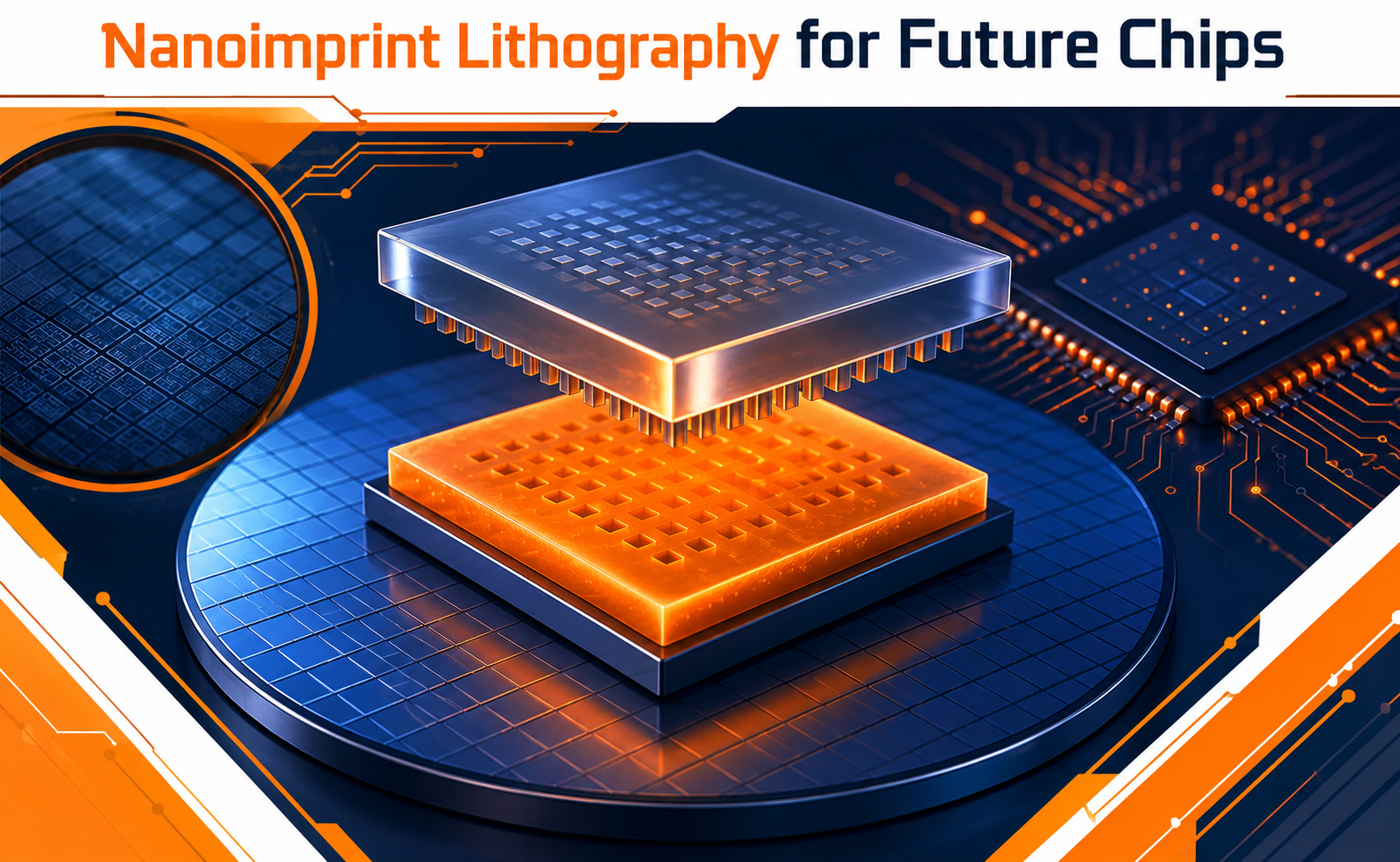
Nanoimprint Lithography (NIL) is an advanced patterning technique used to create extremely small structures on semiconductor wafers. Unlike traditional optical lithography, NIL physically imprints nanoscale patterns onto a resist layer, enabling high-resolution fabrication at lower cost. As chip scaling continues beyond the limits of conventional methods, NIL is emerging as a strong candidate for next-generation semiconductor manufacturing.
Working Principle of Nanoimprint Lithography
NIL works by pressing a patterned hard mold (template) into a soft resist material coated on a wafer. Once the pattern is transferred, the resist is cured using heat or UV light, and the mold is removed, leaving behind a precise nanoscale pattern.
Key steps include:
- Mold fabrication with desired nanostructures
- Resist coating on substrate
- Mechanical imprinting under pressure
- Curing (thermal or UV)
- Mold release and pattern transfer
This direct mechanical approach allows feature sizes well below 10 nm, making it highly suitable for future semiconductor nodes.
Advantages Over Conventional Lithography
Nanoimprint Lithography offers several important benefits compared to optical lithography:
- Ultra-high resolution: Capable of sub-10 nm patterning
- Low cost: No need for complex optics or extreme UV systems
- High throughput potential: Suitable for mass production once optimized
- Energy efficient: Less reliance on high-power light sources
- Material flexibility: Works with various substrates and resists
These advantages make NIL especially attractive for cost-sensitive and high-density chip applications.
Challenges and Limitations
Despite its promise, NIL still faces several technical challenges:
- Defect control: Particle contamination can distort patterns
- Template wear: Repeated use can degrade mold accuracy
- Alignment precision: Difficult for multi-layer semiconductor stacking
- Scalability issues: Integration into existing CMOS fabs is complex
- Process uniformity: Maintaining consistency across large wafers
Ongoing research focuses on improving template durability and reducing defect density for industrial adoption.
Applications in Future Semiconductor Devices
Nanoimprint Lithography is being explored in several cutting-edge applications:
- Advanced memory devices (NAND, emerging non-volatile memory)
- Photonic devices and optical waveguides
- Nanoscale sensors and biosensors
- Quantum devices and nanowire structures
- Display technologies (OLED and micro-LED patterning)
Its ability to create fine, repeated nanoscale patterns makes it highly suitable for both electronics and photonics integration.
Future Outlook
As semiconductor scaling approaches physical and economic limits, Nanoimprint Lithography is positioned as a complementary or alternative technology to EUV lithography. With improvements in defect control, alignment systems, and template engineering, NIL could play a key role in producing next-generation chips that are smaller, faster, and more energy-efficient.
In the future, hybrid lithography systems combining NIL with traditional techniques may become the standard for advanced semiconductor manufacturing.
Share your question in comments or talk to our mentor team for batch guidance.
Ask the Admin Team
Drop your basic question in comments: eligibility, prerequisites, tools, fee range, and placement support.
Our team reviews and responds regularly.