

As semiconductor devices become smaller and manufacturing processes become more precise, surface cleanliness has become a critical factor in semiconductor fabrication. Even extremely small amounts of organic contamination, carbon residues, or unwanted surface films can affect subsequent deposition, lithography, bonding, and device performance.
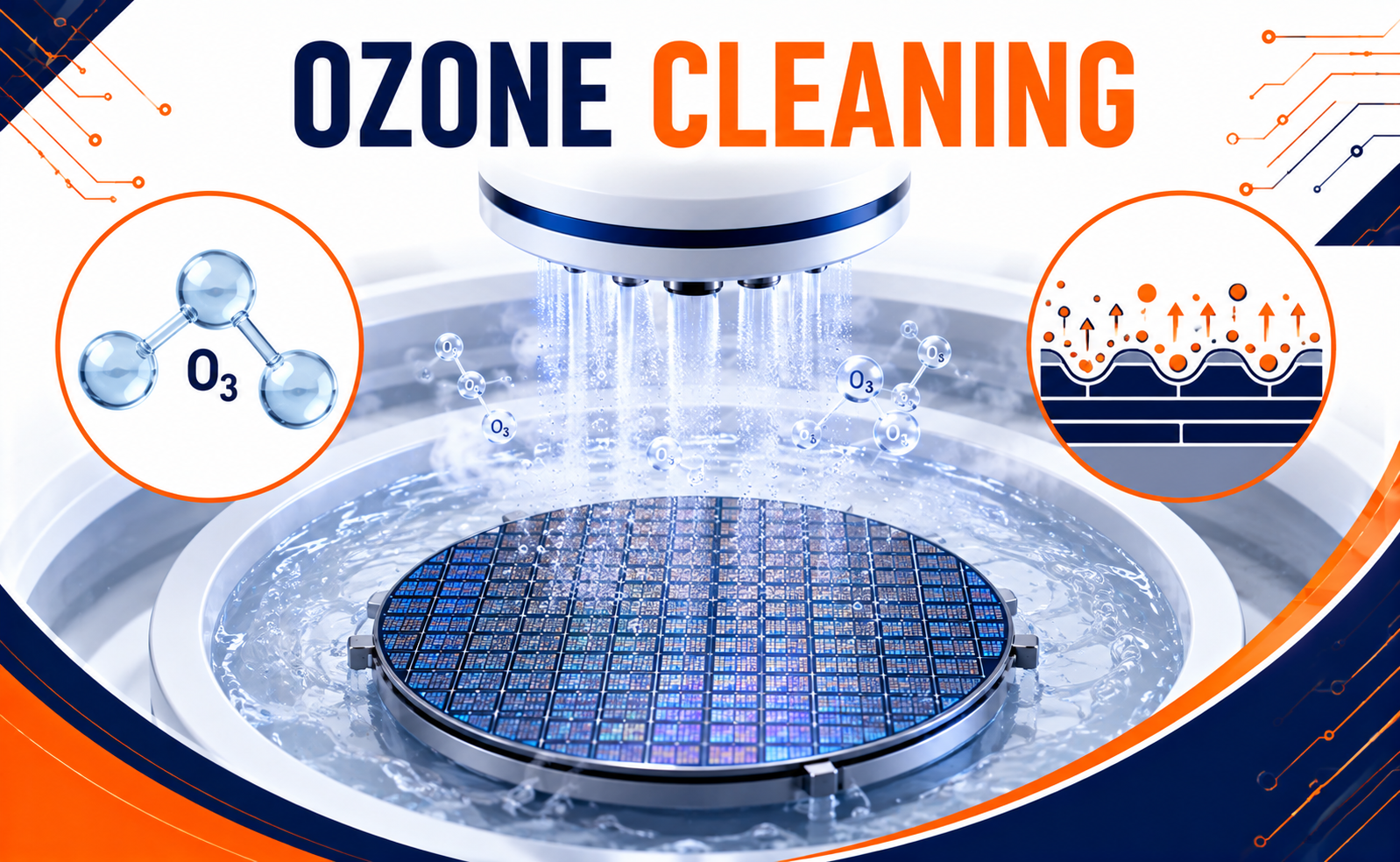
Ozone Cleaning is an advanced semiconductor cleaning technique that uses the strong oxidizing properties of ozone to remove organic contaminants and prepare surfaces for subsequent fabrication steps. It can be implemented using ozone dissolved in water or ozone-containing gas, depending on the application and process requirements.
With its ability to provide effective cleaning while reducing the use of certain conventional chemicals, ozone-based cleaning has become an important technology for modern wafer processing and surface preparation.
What is Ozone Cleaning?
Ozone Cleaning is a surface-cleaning process that uses ozone (O₃) as an oxidizing agent to break down and remove organic contaminants from semiconductor wafers and other process surfaces.
Ozone is highly reactive and can oxidize hydrocarbons and other organic residues into more easily removable products. In semiconductor manufacturing, this makes it useful for cleaning surfaces before critical processing steps.
Depending on the process, ozone can be delivered through:
- Ozone dissolved in ultrapure water
- Ozone-containing gas
- Ozone combined with controlled chemical solutions
- Specialized wafer cleaning systems
The process is designed to remove contamination while maintaining the required surface properties of the wafer.
Why Ozone Cleaning is Important in Semiconductor Manufacturing
Modern semiconductor fabrication requires extremely clean surfaces. Contamination can cause defects, reduce adhesion, interfere with deposition, or negatively affect device characteristics.
Ozone cleaning provides several important benefits:
- Effective removal of organic contamination
- Improved wafer surface cleanliness
- Reduced carbon residues
- Surface preparation before deposition
- Improved bonding and adhesion
- Compatibility with advanced wafer-processing flows
- Potential reduction in certain conventional chemical usage
The importance of ozone cleaning increases as device dimensions shrink and process tolerances become increasingly stringent.
Applications of Ozone Cleaning
Ozone cleaning can be integrated into several semiconductor manufacturing and advanced packaging processes.
Wafer Surface Preparation
Ozone can help remove organic contamination before subsequent wafer fabrication steps.
Pre-Deposition Cleaning
Clean surfaces are essential before processes such as CVD, PVD, and ALD, where contamination can affect film adhesion and uniformity.
Lithography Process Support
Ozone-based cleaning can assist in removing organic residues during selected process flows while maintaining appropriate surface conditions.
Wafer Bonding
Surface cleanliness is particularly important for wafer-to-wafer and die-to-wafer bonding. Ozone treatment can be used as part of surface preparation in appropriate bonding schemes.
Advanced Packaging
Ozone-based processes can also be applied to selected cleaning and surface-preparation steps in advanced semiconductor packaging.
The Future of Ozone Cleaning
As semiconductor manufacturing moves toward smaller technology nodes and increasingly complex integration schemes, advanced cleaning technologies will become even more important.
Future developments in ozone cleaning may focus on:
- More precise ozone concentration control
- Advanced single-wafer cleaning systems
- Automated process monitoring
- AI-assisted cleaning optimization
- Lower water and chemical consumption
- Integration with advanced wafer bonding
- Improved cleaning for 3D semiconductor structures
- Environmentally optimized semiconductor manufacturing
Ozone cleaning may also become increasingly valuable in combination with other surface-treatment technologies as manufacturers develop cleaner and more sustainable process flows.
Conclusion
Ozone Cleaning is an important surface-cleaning technology that uses the strong oxidation properties of ozone to remove organic contamination and prepare semiconductor surfaces for subsequent processing. Its ability to provide effective cleaning while supporting more controlled chemical usage makes it a valuable option for modern wafer fabrication and advanced packaging.
As semiconductor devices continue to become smaller and more complex, maintaining defect-free surfaces will remain essential. Ozone-based cleaning technologies will therefore continue to contribute to the industry’s pursuit of higher wafer quality, improved process reliability, and more sustainable semiconductor manufacturing.
Share your question in comments or talk to our mentor team for batch guidance.
Ask the Admin Team
Drop your basic question in comments: eligibility, prerequisites, tools, fee range, and placement support.
Our team reviews and responds regularly.