

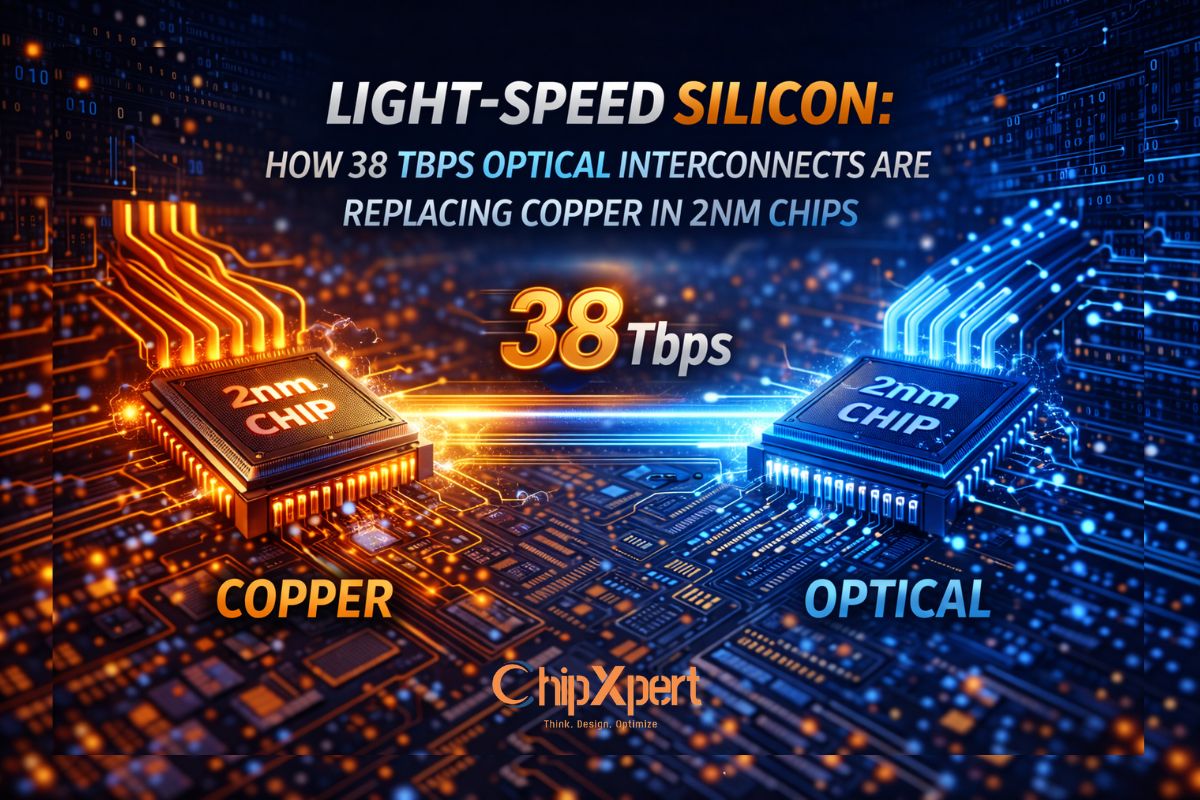
For the better part of sixty years, the semiconductor industry has relied on a simple truth: if you want to move data, you push electrons through copper. However, as we firmly establish the 2nm and 1.4nm nodes in 2026, that truth has hit a physical dead end. We have reached the “Interconnect Bottleneck,” where the energy required to move data across a chip is now greater than the energy required to compute it.
Copper wiring at these microscopic scales suffers from massive resistance, capacitance delays, and thermal throttling. As our AI clusters and data centers demand bandwidth in the tens of terabits per second, copper simply cannot keep up without melting the silicon. The solution isn’t just a new material; it is a new medium. Enter Photon-Driven ICs, where we replace electrical currents with particles of light photons to achieve a staggering 38 Tbps of on-chip communication.
Breaking the 38 Tbps Barrier
The leap to 38 Tbps is not just an incremental improvement; it is a paradigm shift. In 2026, leading-edge SoCs are integrating silicon photonics directly onto the die, creating a “Hybrid Electronic-Photonic” architecture. By using light, we can move data at the speed of light with almost zero heat dissipation.
This bandwidth is achieved through Wavelength Division Multiplexing (WDM). Much like a prism splits white light into a rainbow, WDM allows us to send hundreds of different data streams simultaneously through a single silicon waveguide, each on a slightly different color (wavelength) of light. In a 38 Tbps design, we are now managing thousands of these parallel channels, effectively creating a multi-lane fiber-optic superhighway inside a single square centimeter of silicon.
Why Photonics is the “Missing Link” for 2nm Chips
As we look at the 2nm designs of 2026, silicon photonics solves three critical “crises” that copper could not:
1. The Energy-Per-Bit Crisis
In traditional copper interconnects, moving one bit of data consumes significant energy due to electrical resistance. Silicon photonics reduces this consumption to less than 0.1 picojoules per bit. For a 38 Tbps chip, this translates to a 70% reduction in total interconnect power, allowing AI accelerators to run faster without hitting their thermal limits.
2. The Latency Crisis
Electrons in a wire move significantly slower than the speed of light due to the “RC delay” (resistance and capacitance) of the metal. Photons, however, travel through silicon waveguides with almost zero latency. For real-time applications like autonomous vehicle perception or high-frequency trading, this near-instantaneous on-chip communication is the difference between a successful action and a catastrophic delay.
3. The Density Crisis
To get more bandwidth with copper, you need more wires. At 2nm, there is simply no room left for more metal. Silicon photonics uses a single waveguide to carry the data equivalent of hundreds of copper wires. This “Bandwidth Density” allows us to build smaller, more powerful chips that were previously thought impossible.
Co-Packaged Optics (CPO): The 2026 Integration Standard
One of the most significant trends in 2026 is the move toward Co-Packaged Optics (CPO). Instead of having a separate optical transceiver on the edge of the board, the laser and modulators are placed directly inside the chip package, millimeters away from the CPU or GPU cores.
This proximity is what enables the 38 Tbps throughput. By shortening the electrical path to the absolute minimum, we eliminate the signal integrity issues that plague high-speed SerDes (Serializer/Deserializer) designs. At companies specializing in advanced integration, the focus has shifted from “How do we route this?” to “How do we align this?” as the precision required to couple light into a 2nm chip is measured in nanometers.
Challenges: The Heat and the Light
Despite the “magic” of photonics, 2026 has brought its own set of engineering challenges.
- Thermal Tuning: Silicon waveguides are sensitive to temperature. As the chip heats up, the refractive index changes, which can “detune” the light channels. Engineers are now using tiny on-chip heaters and AI-driven control loops to keep the optical paths perfectly aligned in real-time.
- Laser Integration: Silicon itself does not emit light well. Integrating Indium Phosphide (InP) lasers onto a silicon wafer is a complex manufacturing feat that foundries are only now mastering at scale.
Conclusion: The Speed of Light in Your Pocket
Photon-driven ICs are no longer a laboratory experiment. In 2026, they are the backbone of the global AI infrastructure. By harnessing silicon photonics to reach 38 Tbps, we have effectively bypassed the physical limits of electricity.
For the next generation of VLSI engineers, the challenge is clear: you are no longer just designing circuits; you are designing optical networks. Understanding the physics of light is now just as important as understanding the physics of the transistor. The era of the “Electron-Only” chip is ending, and the era of light-speed silicon has officially begun. The future isn’t just bright, it’s traveling at 300,000 kilometers per second.
Share your question in comments or talk to our mentor team for batch guidance.
Ask the Admin Team
Drop your basic question in comments: eligibility, prerequisites, tools, fee range, and placement support.
Our team reviews and responds regularly.