

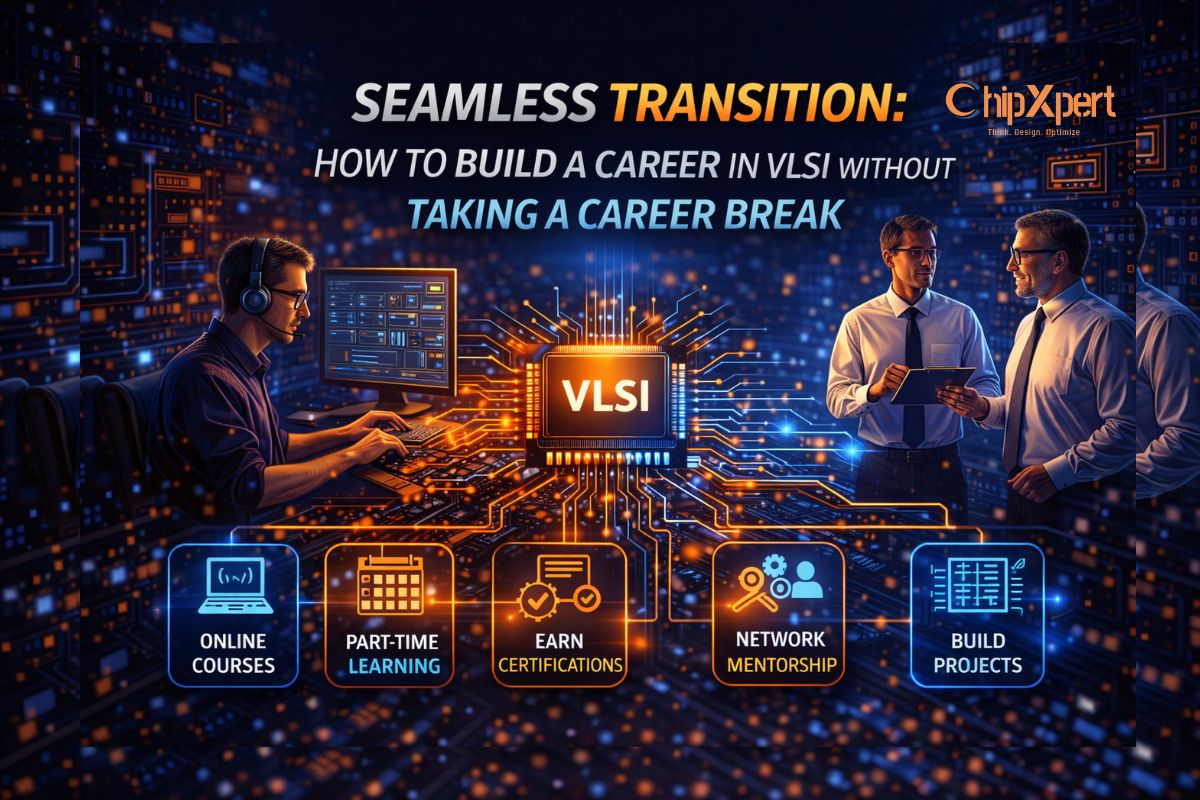
In the fast-moving tech economy of 2026, the semiconductor industry has become the primary destination for engineers looking for long-term stability and high-impact work. Whether you are currently in software development, embedded systems, or even a different branch of electrical engineering, the allure of the 2nm silicon era is undeniable.
However, for many working professionals, the biggest barrier isn’t a lack of interest, it is the fear of the “Career Break.” The idea of quitting a stable job to go back to full-time study is a financial and professional risk that many cannot afford. The good news is that in the modern ecosystem, the “All or Nothing” approach is obsolete. You can pivot to VLSI while maintaining your current professional momentum. Here is the analytical roadmap to making it happen.
1. Leverage the “Adjacent Domain” Strategy
The most successful transitions in 2026 are not total restarts, they are strategic pivots. If you are a software engineer, you already possess skills in C++, Python, and algorithmic thinking. In the VLSI world, these are the exact skills needed for Electronic Design Automation (EDA) tool development or high-level Verification.
By identifying the overlap between your current role and the VLSI flow, you can move into a “bridge” role. For example, moving from embedded software to firmware development for silicon providers allows you to get “closer to the metal.” Once you are inside a semiconductor firm, internal mobility becomes your greatest ally. You can upskill in RTL design or Physical Design while already being on the payroll.
2. Micro-Credentialing and Weekend Immersions
The educational landscape has shifted away from expensive, multi-year degrees toward high-intensity, industry-aligned certifications. In 2026, specialized institutes offer “Working Professional” tracks specifically designed for those who cannot commit to a 9-to-5 schedule.
These programs often focus on a specific, high-demand niche such as Design for Testability (DFT) or Static Timing Analysis (STA). By dedicating your weekends to mastering industry-standard tools like industry-standard synthesis tools or industry-standard PnR tools, you build a portfolio of “tape-out ready” projects. The key is consistency. Two hours of focused study every evening is more effective for a working professional than a frantic month-long sprint.
3. Virtual Labs: The 24/7 Design Center
One of the historical hurdles to learning VLSI was the need for massive, expensive server clusters to run EDA tools. In 2026, the cloud has democratized access. Most top-tier training platforms now provide “Virtual Lab” access that you can log into from your home laptop.
This means you can practice floorplanning a 5nm block or debugging a UVM testbench at midnight after your workday ends. Having hands-on experience with the actual software used by Intel or NVIDIA is the only way to prove to a recruiter that you don’t need “training wheels.” When you walk into an interview, you can show them the actual log files and reports from your virtual lab sessions.
4. Networking Within the Ecosystem
In the semiconductor industry, who you know is often as important as what you know. Since you are already working, use your professional status to attend industry webinars, join specialized hardware forums, and connect with VLSI leads on professional networks.
Don’t just ask for a job. Ask for “Architectural Insights.” Engaging in technical discussions about the challenges of 3D IC stacking or the impact of Backside Power Delivery shows that you are already mentally living in the world of silicon. Many companies in 2026 prefer hiring an experienced professional from an adjacent field who has shown the initiative to self-teach, rather than a fresh graduate with zero work experience.
5. The “Side Project” Portfolio
In the absence of a VLSI job title, your GitHub or personal portfolio must do the talking. For a hardware aspirant, this means having well-documented RTL code for a RISC-V core, a comprehensive verification plan for a memory controller, or a detailed analysis of a timing closure problem you solved.
By treating your transition as a “Side Project,” you demonstrate a level of discipline and passion that is highly valued. It shows that you are a “Tech Enthusiast” who is willing to put in the work. In many cases, these side projects serve as the “Proof of Concept” that allows a recruiter to take a chance on a candidate without a traditional VLSI background.
Conclusion: The Continuous Growth Mindset
Pursuing a career in VLSI without a break is not just a financial decision; it is a demonstration of the “Continuous Growth” mindset that the 2026 tech world demands. It requires a strategic view of your existing skills and a disciplined approach to acquiring new ones.
The walls between software, system engineering, and silicon are thinner than ever. By leveraging bridge roles, utilizing virtual labs, and focusing on industry-aligned certifications, you can transition into the world of chip design without ever seeing a gap in your resume. The silicon age is expanding, and there is a seat at the table for every engineer who is willing to learn the language of the transistor. Your next paycheck could very well be for designing the future of intelligence.
Share your question in comments or talk to our mentor team for batch guidance.
Need Fee, Duration, or Demo Class Details?
Talk to our admin team for the latest batch plan and career guidance.
Contact Admin TeamAsk the Admin Team
Drop your basic question in comments: eligibility, prerequisites, tools, fee range, and placement support.
Our team reviews and responds regularly.