

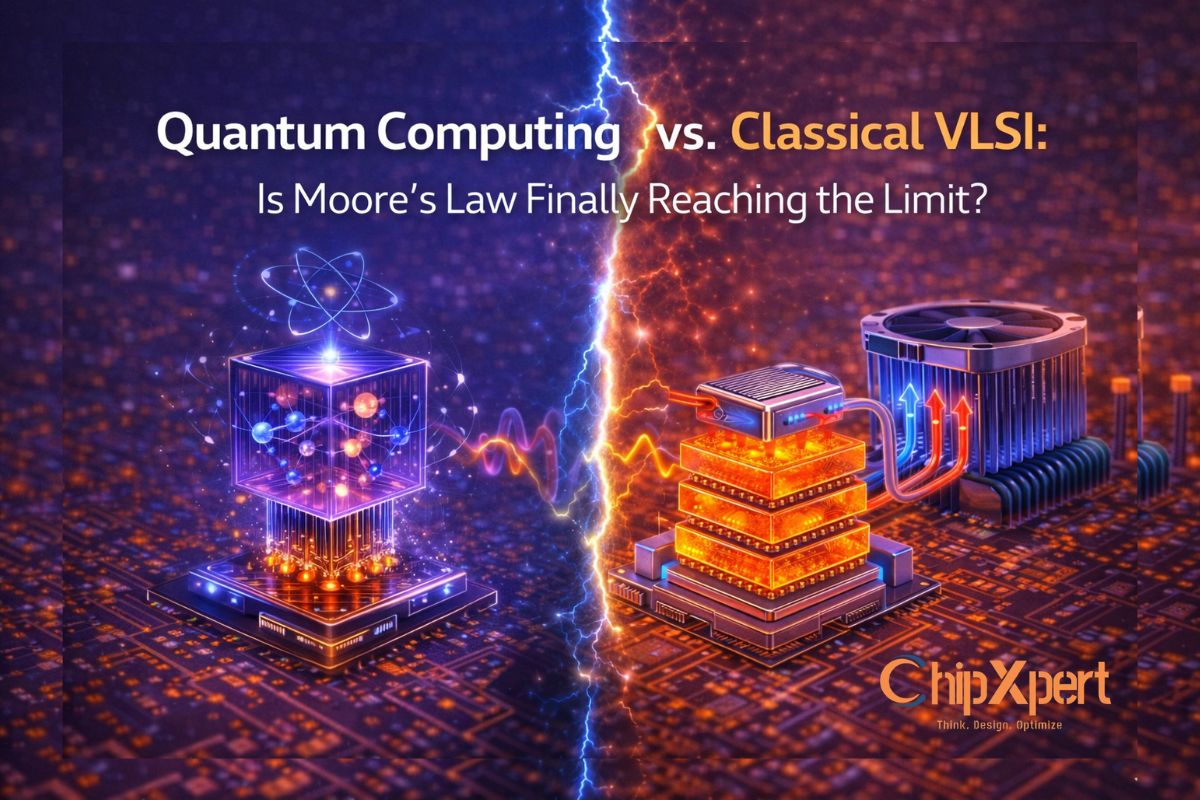
For a B.Tech student entering the electronics field in 2026, the term Moore’s Law feels like both a holy text and a looming deadline. For decades, the Very Large Scale Integration (VLSI) industry has followed the predictable rhythm of doubling transistor density every two years. We have moved from micrometers to nanometers, and now we are discussing the Angstrom era. But as we shrink the gate length of a transistor down to the size of a few silicon atoms, we are hitting a wall made of pure physics.
At these dimensions, classical physics begins to break down, and quantum tunneling takes over. Electrons start jumping through barriers they shouldn’t be able to cross, leading to massive heat and leakage. This has sparked a global debate: Is this the end of the road for classical VLSI, or is Quantum Computing ready to take the torch? To understand the future, we have to look at how these two worlds collide and cooperate.
Classical VLSI: The King is Not Dead Yet
It is a common misconception that Quantum Computing will simply replace your laptop or smartphone. In reality, classical VLSI is more resilient than ever. While we are approaching the “physical limit” of traditional scaling, the industry has pivoted from simple shrinking to structural innovation.
In 2026, we are seeing the mass adoption of Gate All Around (GAA) transistors and Backside Power Delivery (BPD). These are not just smaller transistors, they are entirely new ways of architecting silicon. By wrapping the gate around the channel or moving power lines to the rear of the wafer, engineers have found ways to extend Moore’s Law for at least another decade. Classical VLSI remains the undisputed king of general purpose logic, branch prediction, and high speed memory access. It is the reliable workhorse that powers our current digital civilization.
Quantum Computing: The Specialized Challenger
Quantum Computing operates on a completely different set of rules. While a classical bit is either a 0 or a 1, a Quantum Bit or Qubit exists in a superposition of both. This allows quantum systems to solve specific mathematical problems, such as prime factorization, molecular simulation, and complex optimization, at speeds that would take a classical supercomputer millions of years.
However, the challenge for 2026 is scaling. While classical VLSI can pack billions of transistors onto a thumbnail, quantum computers are still struggling to maintain a few thousand stable qubits. These qubits are incredibly sensitive to noise and heat, requiring dilution refrigerators that operate at temperatures colder than deep space. For the aspiring engineer, the “Quantum vs. VLSI” debate isn’t about replacement, it’s about a shift in the computing hierarchy.
The 2026 Reality: Hybrid Architectures
As we look at the industry landscape today, the most exciting development is not the death of Moore’s Law, but the birth of the hybrid era. We are beginning to see “Quantum Accelerators” sitting alongside classical CPU and GPU clusters in data centers.
The interface between these two worlds is where the most significant VLSI innovation is happening right now. We need classical CMOS circuits that can operate at cryogenic temperatures to control qubits. This field, known as Cryo-CMOS, requires VLSI engineers to redesign traditional circuits to function at 4 Kelvin or lower. This is a massive opportunity for B.Tech students. The skills you learn in digital design and physical layout are now being applied to build the bridges that allow classical computers to talk to quantum ones.
The End of Moore’s Law or a New Beginning?
Is Moore’s Law ending? If you define it as “making transistors smaller,” then yes, we are approaching the finish line. We cannot build a transistor smaller than an atom. However, if you define Moore’s Law as “the exponential growth of computing power,” then we are just getting started.
The industry is moving into the era of Heterogeneous Integration and Chiplets. Instead of trying to put everything on one massive, perfect piece of silicon, we are building smaller, specialized “chiplets” and stacking them in 3D. This allows us to mix different technologies, perhaps a classical AI engine stacked on top of a high speed memory die, all connected via silicon photonics. This 3D revolution is keeping the spirit of Moore’s Law alive without needing to shrink the transistor any further.
Advice for the Next Generation of Engineers
For students currently in the lab, the takeaway is clear: do not pick a side. The most valuable engineers in 2026 are those who understand the fundamentals of classical VLSI but can speak the language of quantum mechanics and system level integration.
Focus on mastering the basics of CMOS logic, timing analysis, and physical design. These are the “first principles” that will never go out of style. But keep a close eye on emerging trends like 3D-IC, silicon photonics, and superconducting logic. The “end” of Moore’s Law is actually the most exciting time to be an engineer because it forces us to be creative again. We can no longer rely on the foundry to give us more performance for free; we have to engineer it through smarter architectures and new materials.
Conclusion: A Symbiotic Future
Quantum Computing and Classical VLSI are not enemies. They are two different tools in the same toolbox. Classical VLSI will continue to provide the backbone for our daily lives, while Quantum Computing will solve the “impossible” problems of science and medicine.
We are not witnessing the end of an era, but a transition into a multi dimensional age of computing. Whether you are designing the next 2nm mobile processor or the control logic for a 10,000 qubit system, the principles of VLSI remain your greatest asset. The limit is no longer the size of the transistor, but the depth of our imagination.
Share your question in comments or talk to our mentor team for batch guidance.
Need Fee, Duration, or Demo Class Details?
Talk to our admin team for the latest batch plan and career guidance.
Contact Admin TeamAsk the Admin Team
Drop your basic question in comments: eligibility, prerequisites, tools, fee range, and placement support.
Our team reviews and responds regularly.