

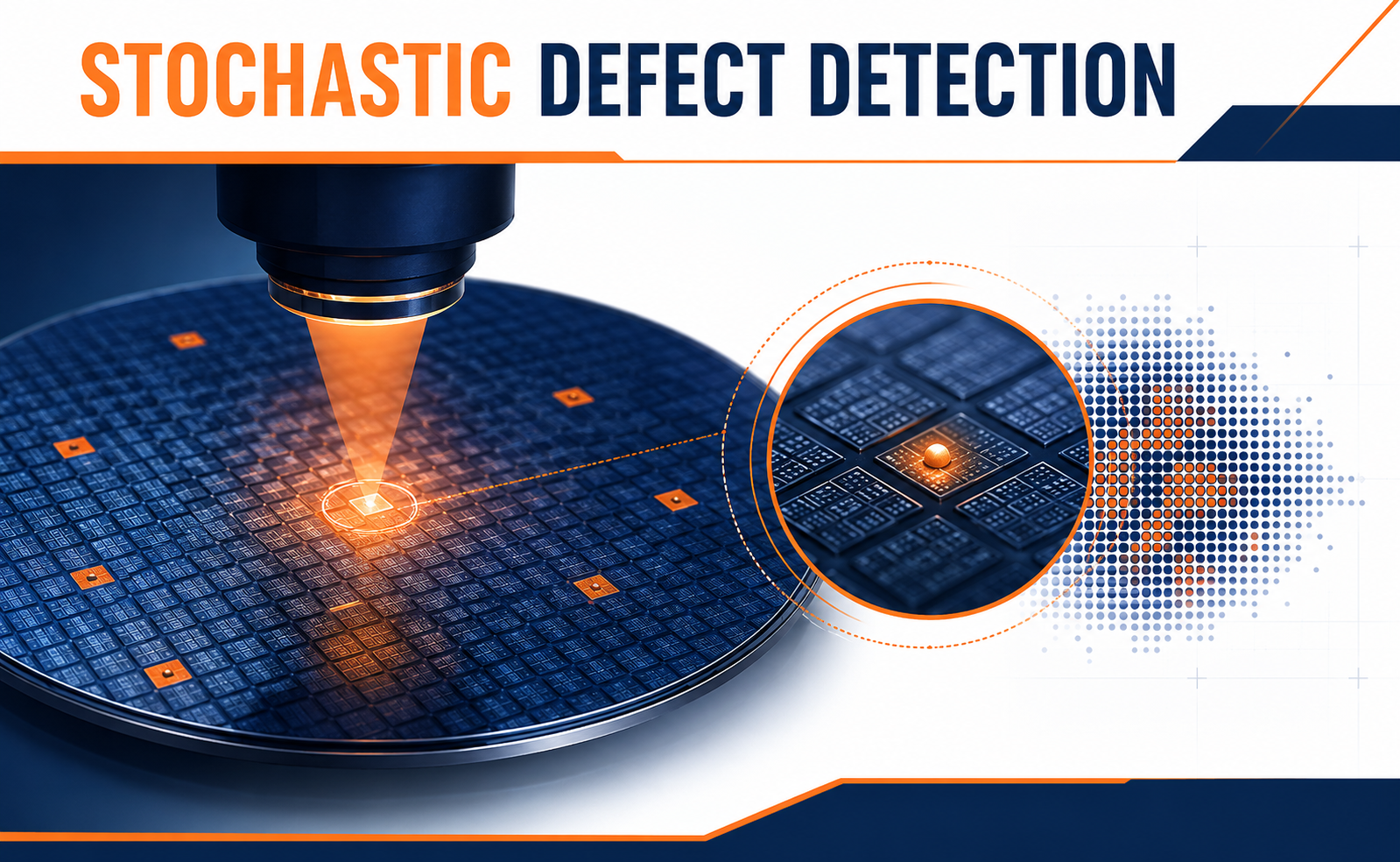
Semiconductor manufacturing depends on identifying defects quickly, accurately, and consistently. While many defects follow recognizable patterns, some occur randomly and unpredictably across wafers, dies, or process steps. These are known as stochastic defects.
Stochastic defect detection focuses on identifying these low-frequency, randomly distributed defects and determining whether they are isolated events or indicators of an emerging process problem. With advanced semiconductor nodes becoming increasingly sensitive to process variations, stochastic defect detection has become an important part of yield improvement, process control, and semiconductor quality management.
What Are Stochastic Defects?
A stochastic defect is a defect whose occurrence is governed largely by probability rather than a consistent spatial or systematic pattern. Unlike systematic defects, which may repeatedly appear at similar locations or follow a recognizable signature, stochastic defects can appear sporadically across a wafer.
Examples include:
- Random particle contamination
- Isolated lithography failures
- Random patterning defects
- Occasional line-edge or line-width variations
- Random contact or via failures
- Localized material or process anomalies
Although an individual stochastic defect may appear insignificant, a small increase in its occurrence can become an early indicator of process degradation.
Why Stochastic Defect Detection Matters
As semiconductor geometries shrink, manufacturing processes operate with increasingly narrow process margins. A defect that was previously tolerated may become yield-limiting at an advanced technology node.
The challenge is that stochastic defects are difficult to distinguish from normal process variation. Detection systems must therefore identify unusual events without generating excessive false alarms.
Effective stochastic defect detection helps manufacturers:
- Improve wafer and die yield
- Detect process instability at an early stage
- Identify contamination events
- Reduce undetected reliability risks
- Support faster root-cause analysis
- Improve process control and manufacturing consistency
The goal is not simply to find more defects, but to extract meaningful information from rare defect events.
Detection and Analysis Techniques
Stochastic defect detection typically combines inspection, measurement, statistical analysis, and automated classification.
High-resolution optical and electron-beam inspection can identify subtle physical anomalies that may not be visible through conventional inspection methods. Once detected, defects can be classified according to their type, location, size, process layer, and frequency.
Statistical techniques are particularly important because stochastic defects are often characterized by low occurrence rates. Engineers can analyze defect distributions, defect density, spatial randomness, and changes over multiple wafers or process lots.
Machine learning can further enhance this process by recognizing subtle relationships between defect signatures and manufacturing conditions. Automated classification can help separate random defects from systematic patterns and prioritize events that require engineering investigation.
Future of Stochastic Defect Detection
The future of stochastic defect detection will increasingly combine high-resolution inspection, statistical modeling, artificial intelligence, and real-time manufacturing data.
AI-driven systems can help identify rare defect patterns, compare large numbers of inspection results, and detect subtle shifts in defect behavior. Advanced analytics can also support predictive approaches, where manufacturing teams identify conditions associated with increasing stochastic defect probability before significant yield loss occurs.
As semiconductor manufacturing moves toward increasingly complex architectures and smaller dimensions, the ability to detect and understand rare defects will become even more important.
Conclusion
Stochastic defects may occur randomly, but their impact on semiconductor manufacturing can be significant. Detecting these defects requires more than simply increasing inspection sensitivity it requires intelligent analysis capable of separating genuine process signals from normal variation.
By combining advanced inspection, statistical analysis, machine learning, and process data correlation, semiconductor manufacturers can identify rare defects earlier, improve yield, strengthen process control, and build more reliable devices.
Stochastic defect detection is therefore becoming a critical capability for maintaining semiconductor manufacturing quality in an increasingly complex technology landscape.
Share your question in comments or talk to our mentor team for batch guidance.
Ask the Admin Team
Drop your basic question in comments: eligibility, prerequisites, tools, fee range, and placement support.
Our team reviews and responds regularly.