

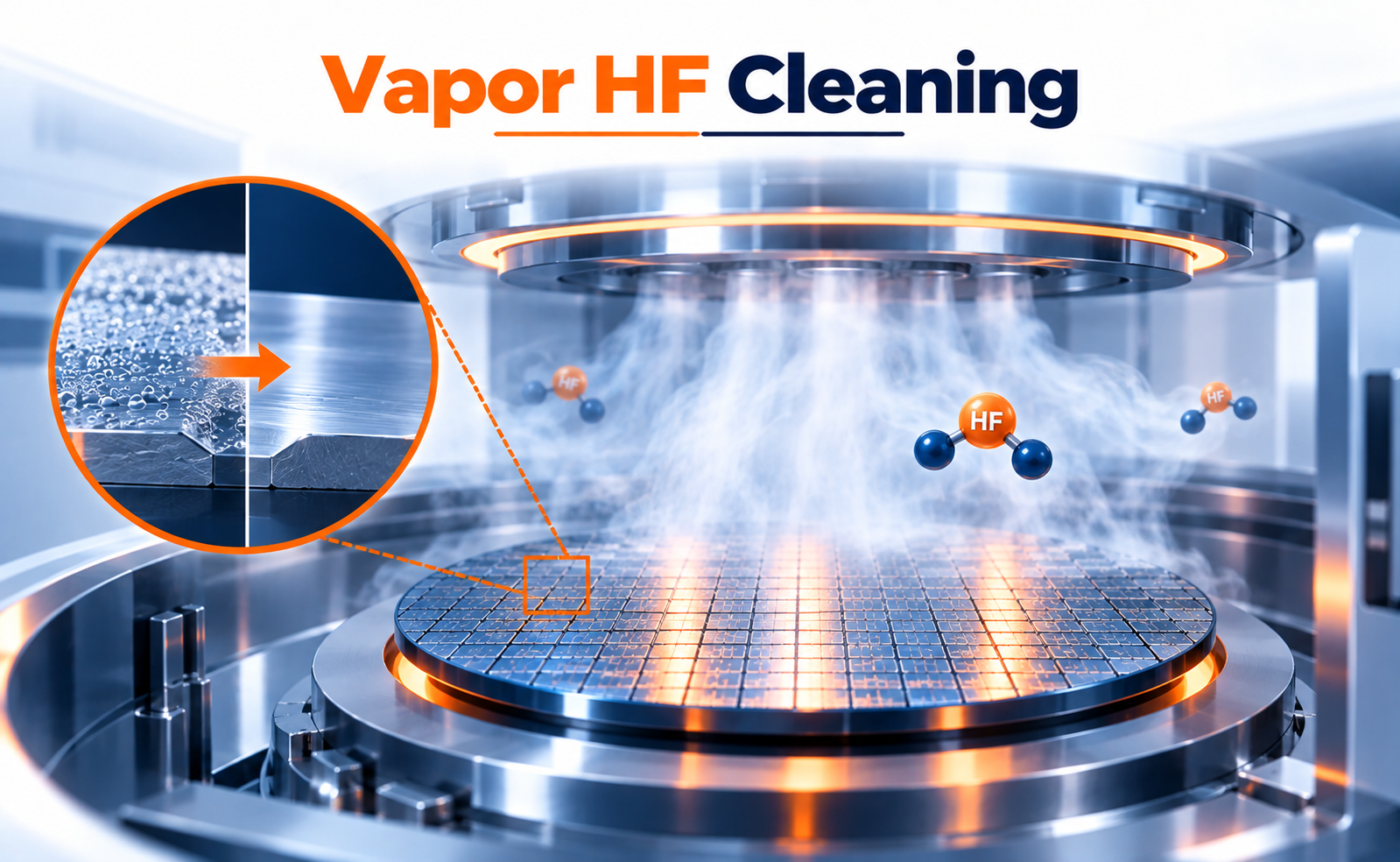
As semiconductor devices continue to shrink, wafer surfaces must be prepared with increasingly precise control. Even extremely thin native oxide layers, residues, or contaminants can affect subsequent deposition, etching, bonding, and electrical performance.
Vapor HF (Hydrogen Fluoride) Cleaning is a dry or vapor-phase surface treatment used in semiconductor manufacturing to selectively remove silicon oxide and prepare surfaces for subsequent process steps. Compared with conventional wet HF cleaning, vapor-phase processing can provide improved control for selected applications while reducing liquid-related process challenges.
What Is Vapor HF Cleaning?
Vapor HF cleaning uses hydrogen fluoride in the vapor phase to chemically remove oxide films from semiconductor surfaces.
In a typical process, the wafer is exposed to controlled HF-containing vapor under carefully managed temperature, pressure, and chemical conditions. The HF reacts with silicon oxide, converting it into volatile or removable reaction products.
A simplified process can be represented as:
Wafer Surface → Controlled Vapor Exposure → Oxide Removal → Surface Conditioning → Next Process
The technique is particularly useful when highly controlled oxide removal is required without immersing the wafer in a liquid chemical solution.
Why Is Vapor HF Cleaning Important?
Surface cleanliness and oxide control become increasingly important as semiconductor dimensions shrink.
Precise Oxide Removal
Vapor HF can provide controlled removal of thin oxide films, making it useful for processes where oxide thickness must be tightly managed.
Reduced Liquid Handling
Because the process uses vapor rather than wafer immersion, it can eliminate some challenges associated with liquid chemical handling and drying.
Improved Surface Accessibility
Vapor-phase chemistry can reach complex surface structures and small features where uniform liquid processing may present challenges.
Process Integration
Vapor HF cleaning can be integrated into process flows where oxide removal needs to occur close to a subsequent deposition, etch, or bonding operation.
Reduced Water-Related Effects
Dry processing can help avoid certain problems associated with liquid processing, such as watermarks, capillary effects, and liquid entrapment in suitable structures.
Applications in Semiconductor Manufacturing
Vapor HF cleaning can be used in several semiconductor process and packaging applications.
Pre-Deposition Cleaning:
Oxide removal can prepare surfaces before selected thin-film deposition processes, improving interface quality.
Contact and Via Processing:
Removing unwanted oxide from contact regions can help prepare surfaces for subsequent metallization.
MEMS Manufacturing:
Vapor-phase HF processes can be used in selected MEMS fabrication flows where controlled oxide removal or release is required.
Advanced Packaging:
Surface preparation can be important for certain wafer-level packaging and interconnect processes.
3D Semiconductor Integration:
As structures become more complex, controlled dry cleaning can support surface preparation before selected bonding or deposition steps.
The Future of Vapor HF Cleaning
As semiconductor manufacturing moves toward smaller geometries, 3D structures, advanced materials, and increasingly complex packaging, surface preparation will require greater precision.
Future developments in vapor HF cleaning are expected to emphasize:
- Improved oxide-removal uniformity
- Greater process selectivity
- Better control of nanoscale surface conditions
- Advanced chamber and chemical management
- Integration with automated process control
- Improved compatibility with complex 3D structures
- In-line surface metrology and monitoring
- Higher wafer throughput
The ability to precisely control surfaces before critical manufacturing steps will become increasingly important as semiconductor process windows continue to narrow.
Conclusion
Vapor HF Cleaning is an important dry surface-treatment technology for controlled oxide removal in semiconductor manufacturing. By using vapor-phase chemistry instead of conventional liquid immersion, it can provide valuable process advantages for selected applications requiring precise surface preparation.
From pre-deposition cleaning and contact processing to MEMS, advanced packaging, and 3D integration, vapor HF technology can help maintain the surface conditions required for reliable downstream processing.
As semiconductor structures become smaller and more complex, the combination of controlled vapor chemistry, precise process monitoring, surface metrology, and advanced equipment engineering will remain essential for achieving consistent wafer quality and manufacturing performance.
Share your question in comments or talk to our mentor team for batch guidance.
Ask the Admin Team
Drop your basic question in comments: eligibility, prerequisites, tools, fee range, and placement support.
Our team reviews and responds regularly.