

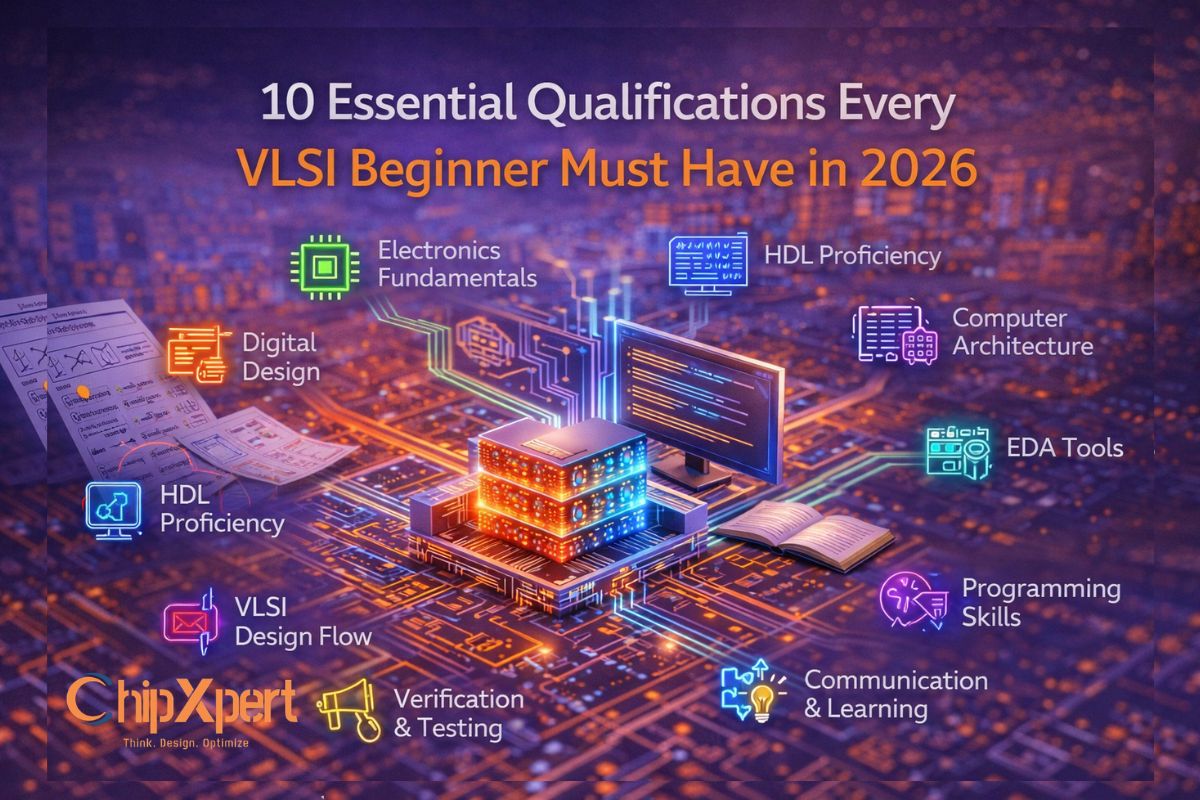
The semiconductor industry is evolving faster than ever, driven by innovations in AI, automotive electronics, and advanced computing systems. As companies continue to push toward smaller nodes and more complex chip architectures, the demand for skilled VLSI engineers is increasing significantly.
However, breaking into the VLSI industry as a beginner is not just about having a degree. Employers in 2026 expect candidates to possess a combination of strong fundamentals, practical skills, and industry awareness. Understanding what qualifications matter the most can help you build a strong foundation and improve your chances of landing your first job.
In this article, we explore the most important qualifications every VLSI beginner should focus on.
Strong Foundation in Electronics Fundamentals
A solid understanding of core electronics is the starting point for any VLSI career. Concepts such as digital logic, semiconductor devices, CMOS technology, and circuit analysis form the backbone of chip design.
Without a strong foundation, it becomes difficult to understand advanced topics such as timing analysis, low-power design, or verification methodologies.
Knowledge of Digital Design Concepts
Digital design is at the heart of modern VLSI systems. Beginners should be comfortable with combinational and sequential circuits, finite state machines, and logic optimization techniques.
Understanding how digital circuits behave helps in designing efficient and scalable hardware systems.
Proficiency in Hardware Description Languages
In 2026, knowledge of Hardware Description Languages is no longer optional. Skills in languages such as Verilog, VHDL, or SystemVerilog are essential for designing and verifying digital circuits.
These languages allow engineers to describe hardware behavior and simulate designs before physical implementation.
Familiarity with Computer Architecture
Understanding how processors, memory systems, and peripherals interact is crucial for designing efficient chips. Knowledge of computer architecture helps engineers build designs that align with system-level requirements.
It also improves your ability to work on complex designs such as SoCs and embedded systems.
Hands-on Experience with EDA Tools
Modern chip design relies heavily on Electronic Design Automation (EDA) tools. Beginners should have exposure to tools used for simulation, synthesis, verification, and physical design.
Even basic familiarity with these tools gives you a strong advantage during interviews and real-world projects.
Programming and Scripting Skills
In addition to hardware design, programming skills play an important role in VLSI workflows. Knowledge of languages such as Python, C, or scripting tools helps automate repetitive tasks and improve productivity.
Engineers who can combine hardware knowledge with programming skills are highly valued in the industry.
Understanding of the VLSI Design Flow
A clear understanding of the complete VLSI design flow is essential for beginners. This includes stages such as RTL design, synthesis, placement, routing, verification, and testing.
Knowing how each stage connects to the next helps you understand the bigger picture of chip development.
Basic Knowledge of Verification and Testing
Verification is a critical part of chip design, ensuring that the design works correctly before manufacturing. Beginners should understand basic verification concepts, testbenches, and simulation techniques.
Awareness of testing concepts such as fault detection and validation methods adds further value to your profile.
Problem-Solving and Debugging Skills
VLSI design involves solving complex technical challenges. Engineers must be able to analyze problems, debug errors, and optimize designs.
Strong analytical thinking and debugging skills are often what differentiate an average candidate from a strong one.
Communication and Continuous Learning Mindset
Technical skills alone are not enough. In a collaborative industry like semiconductor design, communication and teamwork are equally important.
Additionally, the VLSI field is constantly evolving. Engineers who stay updated with new technologies, tools, and methodologies have a clear advantage in the long run.
Conclusion
Entering the VLSI industry in 2026 requires more than academic knowledge. It demands a balanced combination of technical expertise, practical exposure, and problem-solving ability.
By focusing on these essential qualifications, beginners can build a strong foundation and position themselves as job-ready candidates in the competitive semiconductor industry.
With the right preparation and continuous learning, you can successfully build a rewarding career in VLSI design.
Share your question in comments or talk to our mentor team for batch guidance.
Need Fee, Duration, or Demo Class Details?
Talk to our admin team for the latest batch plan and career guidance.
Contact Admin TeamAsk the Admin Team
Drop your basic question in comments: eligibility, prerequisites, tools, fee range, and placement support.
Our team reviews and responds regularly.