In my fifteen years of documenting the ebbs and flows of the semiconductor industry, I have seen the “hiring gate” move from the fax machine to the email inbox, and now, to the algorithmic heart of LinkedIn. As we navigate the complex landscape of 2026, where AI-driven chip design and 2nm fabrication are the new norms, your LinkedIn profile is no longer just a digital resume. It is your personal “tape-out,” a public declaration of your technical integrity, your project history, and your potential as a silicon innovator.
Recruiters at firms like NVIDIA, Intel, and the surging VLSI startups in Bangalore and Austin are using advanced AI filters to find talent. If your profile is a static list of “SystemVerilog” and “Synthesis,” you are invisible. To stand out in 2026, you must treat your profile as a high-performance SoC, optimized for visibility, credibility, and engagement.
1. The Headline: Your Architectural Specification
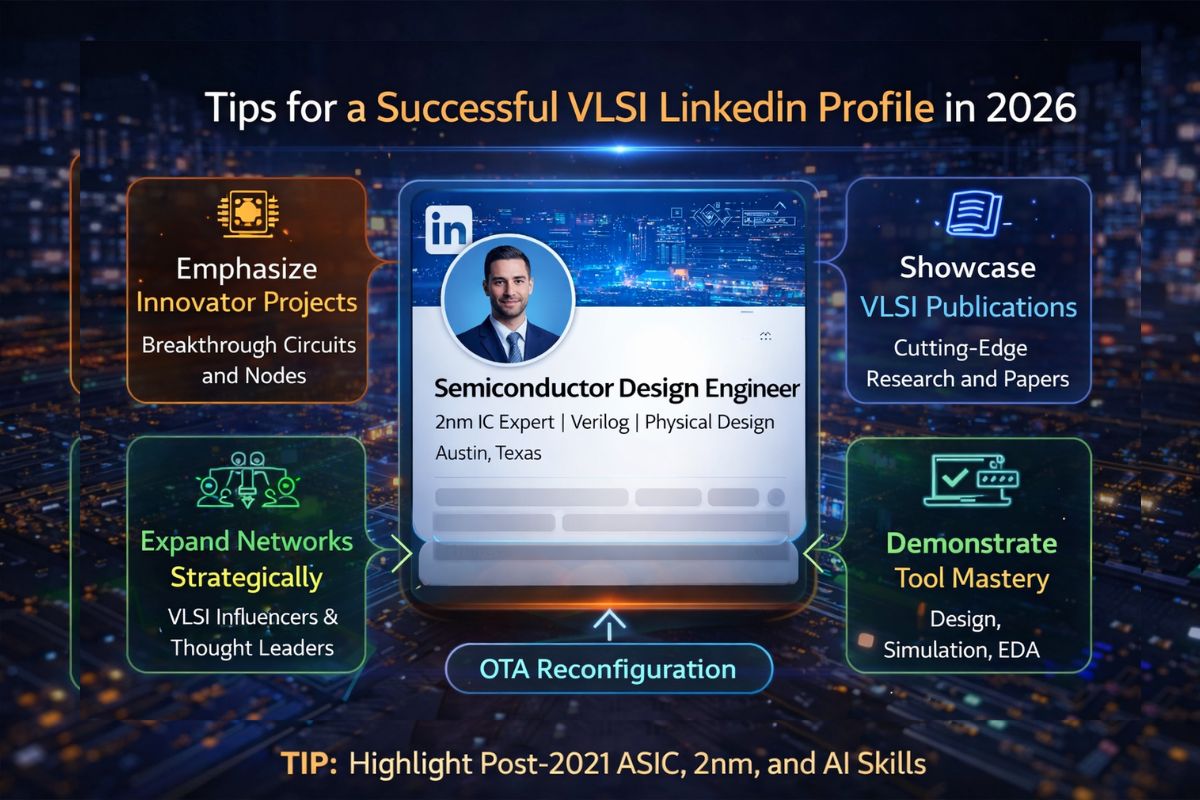
Most engineers make the mistake of using their current job title as their headline. In 2026, that is a wasted opportunity. Your headline should be your “value proposition.” Instead of “Design Verification Engineer at Company X,” try something that highlights your specific niche and seniority.
A high-impact headline for 2026 looks like this: “Lead Verification Architect | UVM & SystemVerilog Expert | Reducing Tape-out Risks for AI Accelerators | 10+ Years in Silicon Excellence.” This tells a recruiter exactly what you do, what tools you use, and the specific problem you solve. It uses industry-standard keywords that the LinkedIn search algorithm prioritizes.
2. The About Section: Your Professional Narrative
The “About” section is where most technical profiles go to die. Avoid the dry, third-person summary. In 2026, the industry values “humanized” technical leadership. Write in the first person. Explain your “why.”
Talk about the first chip you ever saw go to silicon. Describe the adrenaline of solving a critical timing violation at 3:00 AM. Mention your transition from monolithic designs to the world of chiplets and 3D-ICs. This narrative shows that you aren’t just a coder, you are an engineer with a deep, historical understanding of the craft. End this section with a “Technical Stack” bulleted list to ensure the SEO crawlers pick up your expertise in tools like industry-standard synthesis and PnR tools, or specialized PQC hardware accelerators.
3. The Experience Section: Focus on Impact, Not Tasks
In 2026, everyone knows what a Physical Design engineer does. Do not list your daily chores. Instead, use the “Situation, Action, Result” (SAR) method to describe your projects.
Instead of saying “Performed static timing analysis,” say: “Led the STA closure for a 5nm AI training processor, reducing total power consumption by 15% through aggressive clock-gating strategies and meeting a critical quarterly tape-out deadline.” This provides a metric of success. Mention the specific process nodes you have worked on, as “2nm experience” or “18A familiarity” are the high-value search terms of the current year.
4. Skill Endorsements and Recommendations: The Social Proof
In a field as specialized as VLSI, social proof is everything. In 2026, a “Recommendation” from a Lead Architect or a Project Manager carries more weight than a hundred generic endorsements. Reach out to your former colleagues and offer to write them a detailed, genuine recommendation in exchange for one.
Focus on specific skills. A recommendation that says “Ghulam is a wizard at debugging complex UVM testbenches” is far more valuable than “Ghulam is a great hard worker.” These specific phrases act as secondary keywords that boost your profile in niche recruiter searches.
5. Content Authority: The 2026 Differentiator
The most successful VLSI professionals on LinkedIn in 2026 are not just lurking, they are contributing. You do not need to write long essays every day. Simply sharing a news article about the latest High-NA EUV breakthrough and adding two sentences of your own technical perspective is enough.
Commenting on posts from industry leaders shows that you are active in the “Digital Cleanroom.” It signals to recruiters that you are a continuous learner who stays updated on the fast-moving world of backside power delivery or glass substrates. This “content authority” builds trust before you ever sit down for an interview.
6. The Visuals: Professionalism in a High-Tech Era
Your profile picture should be professional, but it does not have to be a suit and tie. A clean, high-resolution photo in a professional setting, or even a modest office environment, works best for our industry. Your banner image is another piece of “real estate” you should use. Instead of a default gradient, use a high-tech image of a wafer, a cleanroom, or a stylized circuit diagram. It immediately tells the viewer that they are in the right place.
Conclusion: Your Career, Optimized
The semiconductor world is smaller than you think. In 2026, your reputation precedes you through your LinkedIn profile. By optimizing your headline, humanizing your narrative, and focusing on measurable impact, you move from being just another resume in the pile to being a sought-after expert in the silicon ecosystem.
Mastering LinkedIn is an engineering task like any other. It requires a clear specification, a robust architecture, and constant iteration. Start today by updating your headline and “About” section. In the high-stakes era of 2026 silicon, your digital presence is the foundation upon which your next great career leap will be built.
Share your question in comments or talk to our mentor team for batch guidance.
Need Fee, Duration, or Demo Class Details?
Talk to our admin team for the latest batch plan and career guidance.
Contact Admin TeamAsk the Admin Team
Drop your basic question in comments: eligibility, prerequisites, tools, fee range, and placement support.
Our team reviews and responds regularly.