

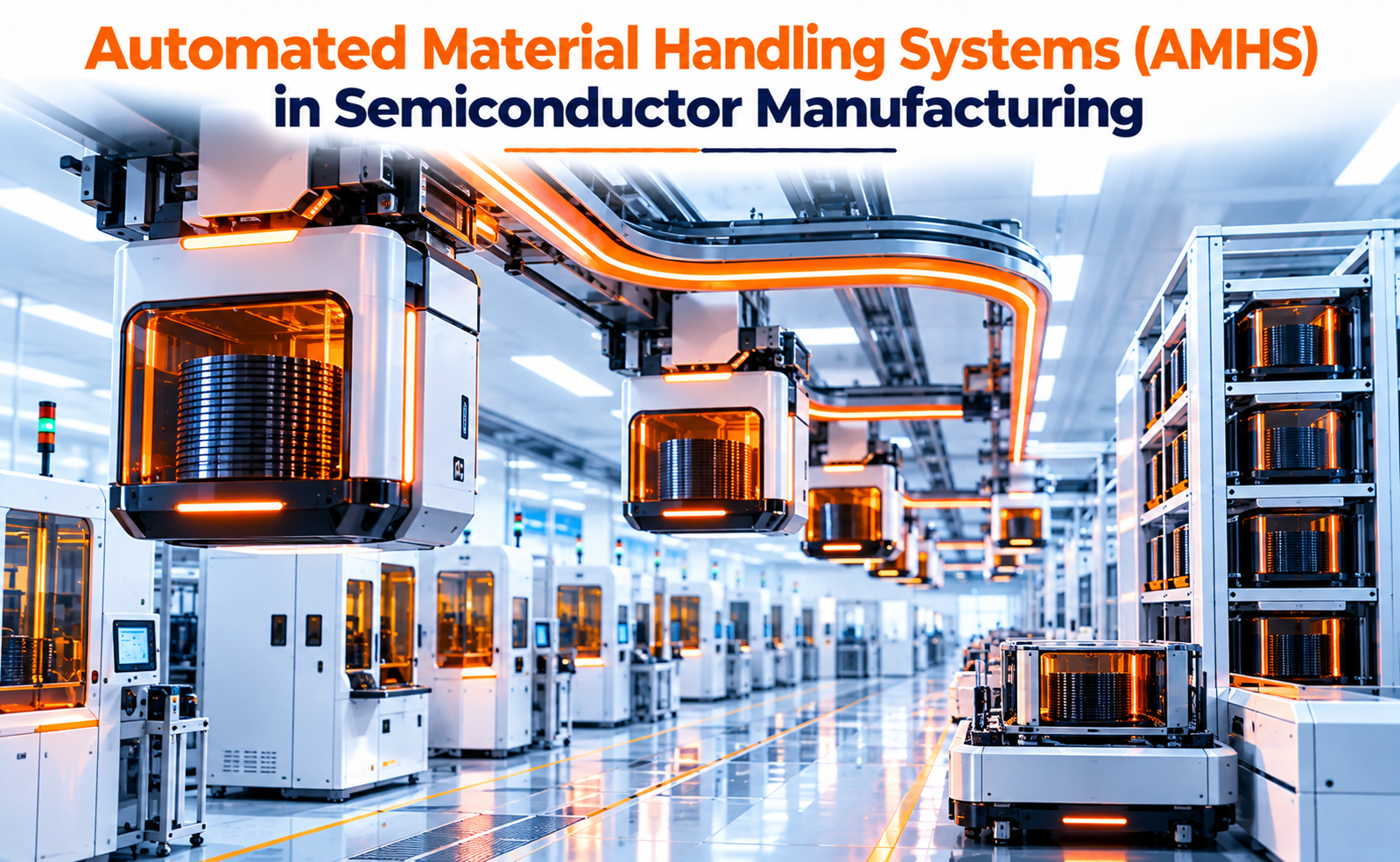
Modern semiconductor fabs are highly automated environments where wafers move through hundreds of process and inspection steps before becoming finished semiconductor devices. With advanced manufacturing nodes requiring extremely tight process control, manually transporting wafers between tools is no longer practical.
This is where Automated Material Handling Systems (AMHS) play a critical role.
AMHS is the automated infrastructure used to transport, store, route, and manage semiconductor materials particularly wafer carriers such as FOUPs (Front Opening Unified Pods) throughout a fabrication facility. By connecting process equipment, stockers, loading stations, and production areas, AMHS helps create a highly coordinated manufacturing environment.
What Is an Automated Material Handling System?
An Automated Material Handling System (AMHS) is a combination of hardware, software, communication networks, and control systems designed to automatically move semiconductor materials throughout a fab.
Instead of relying on operators to manually transport wafer carriers, AMHS equipment receives transportation requests and automatically delivers the required carrier to the appropriate manufacturing tool.
A typical AMHS environment can include:
- Overhead hoist transport (OHT) vehicles
- Automated guided vehicles (AGVs)
- Rail-guided vehicles
- Conveyor systems
- Automated storage and retrieval systems
- Stockers
- Load ports
- Wafer carrier handling systems
- Sensors and identification systems
- Manufacturing execution and control software
In a 300 mm fab, wafers are typically transported inside standardized FOUPs, which protect the wafers from contamination during movement between process areas.
The objective is simple: move the right material to the right tool at the right time while maintaining safety, cleanliness, and traceability.
Major Components of an AMHS
An AMHS is not a single machine. It is an interconnected system consisting of transportation, storage, control, and communication technologies.
Overhead Hoist Transport
OHT systems use vehicles suspended from overhead tracks to transport FOUPs throughout the fab.
Because the transportation network is positioned above the manufacturing floor, valuable floor space can remain available for process equipment and operators.
Automated Storage Systems
Automated stockers temporarily store wafer carriers until they are needed for the next manufacturing step.
They can automatically retrieve and deliver carriers based on production requirements.
Load Ports
Load ports provide the interface between the material handling system and semiconductor manufacturing equipment.
They enable automated carrier transfer while maintaining the controlled environment required for wafer processing.
Sensors and Identification
Sensors help detect carrier position, vehicle movement, obstacles, and system conditions.
Carrier identification systems allow the fab to maintain material traceability throughout the manufacturing process.
Control Software
The software layer coordinates transportation requests, vehicle dispatching, routing, storage, and system status.
It works alongside manufacturing-control systems to synchronize material movement with production operations.
Together, these components create an automated transportation infrastructure spanning the semiconductor fab.
Why Is AMHS Important in Semiconductor Manufacturing?
A modern semiconductor fab processes extremely large numbers of wafer lots across many different process steps. Any delay in material movement can affect equipment utilization and overall production efficiency.
AMHS provides several important benefits.
Improved Productivity
Automated transportation reduces the time required to move materials between process tools.
Reduced Human Handling
Minimizing manual handling reduces the possibility of contamination, handling damage, and operator-related errors.
Better Traceability
Automated systems can record carrier movements, destinations, timestamps, and transportation events.
Improved Equipment Utilization
Efficient material delivery helps process equipment receive the required lots without unnecessary waiting.
Cleanroom Compatibility
Automated carrier transportation reduces unnecessary human movement inside highly controlled manufacturing areas.
Consistent Material Flow
AMHS can coordinate transportation according to production priorities, helping maintain a predictable flow of material through the fab.
For advanced semiconductor manufacturing, these benefits are particularly important because production involves many interconnected process steps and expensive equipment.
The Future of AMHS in Smart Semiconductor Fabs
The future of AMHS is closely connected to the development of smart and highly autonomous semiconductor fabs.
As semiconductor manufacturing becomes increasingly data-driven, AMHS can evolve from simply transporting materials to actively optimizing factory operations.
Future developments are expected to focus on:
- AI-assisted transportation optimization
- Predictive maintenance
- Real-time traffic management
- Autonomous vehicle coordination
- Dynamic route optimization
- Digital twins of material-flow networks
- Energy-efficient transportation
- Advanced production scheduling
- Real-time equipment and carrier tracking
- Greater integration with factory-wide automation systems
AI and analytics can potentially use historical transportation data to identify congestion patterns, predict equipment or vehicle issues, and optimize carrier movement before production delays occur.
The AMHS can therefore become an important part of a fully connected smart fab, where material movement, equipment status, production scheduling, and manufacturing data are continuously coordinated.
Conclusion
Automated Material Handling Systems are a fundamental part of modern semiconductor manufacturing.
By automatically transporting and storing wafer carriers, AMHS reduces manual handling, improves traceability, supports cleanroom requirements, and helps maintain efficient material flow between thousands of process operations.
As semiconductor fabs become larger, more automated, and more complex, the importance of intelligent material transportation will continue to grow.
The next generation of AMHS will go beyond simple automated transport. Through AI, predictive analytics, real-time optimization, robotics, and smart-factory integration, AMHS can become an intelligent layer that helps semiconductor fabs achieve higher productivity, greater reliability, and more efficient manufacturing.
Share your question in comments or talk to our mentor team for batch guidance.
Ask the Admin Team
Drop your basic question in comments: eligibility, prerequisites, tools, fee range, and placement support.
Our team reviews and responds regularly.