

For many young engineers in South India, becoming a VLSI Engineer is a dream career. Most VLSI Students come from an ECE background and wonder how to bridge the gap between theory and industry skills. This guide will show the exact path for an ECE Student to VLSI Engineer transformation — step by step.
Why VLSI Is the Most Promising Career for South Indian Engineers
The semiconductor boom has made VLSI one of the fastest-growing fields in India. Bengaluru, Hyderabad, Chennai, and Coimbatore are becoming semiconductor hubs with companies hiring thousands of freshers. For ECE students who want long-term growth, VLSI offers stability, high packages, and global opportunities.
Understanding the VLSI Industry and Its Job Roles
VLSI engineering is divided into multiple career paths. Some of the most in-demand roles include:
- RTL Design Engineer
- Design Verification Engineer
- Physical Design Engineer
- DFT Engineer
- Synthesis Engineer
- STA Engineer
- Analog Layout Engineer
Knowing these roles helps VLSI Students plan their skills and choose the right direction.
Roadmap for ECE Student to VLSI Engineer
An ECE graduate already has the foundation — electronics, semiconductors, and digital design. But to get into VLSI, you must upgrade with industry-oriented skills like:
- Verilog / SystemVerilog
- UVM Methodology
- Scripting (Python, Tcl, Shell)
- industry-standard EDA tools / Mentor Tools
- CMOS Concepts
- STA, CTS, Floorplanning (for PD roles)
This practical skill set sets you apart from regular graduates.

Learning Digital Logic and HDL the Right Way
Most colleges teach the basics, but companies expect hands-on knowledge. You should be able to:
- Write synthesizable Verilog
- Understand timing diagrams
- Build combinational & sequential circuits
- Debug simulations
- Work with waveform tools
This is the foundation every VLSI Student must master.
Why Training Matters – The Skill Gap Between College and Industry
Top recruiters expect project-based knowledge, not just theory. That’s why most ECE graduates struggle to crack VLSI interviews. Hands-on labs, tool experience, and real-time projects help bridge the industry gap effectively.
This is where choosing the Best VLSI Institute in Bengaluru makes a huge difference.
How to Choose the Best VLSI Institute in Bengaluru
Here’s how VLSI Students can identify a good training institute:
- industry-standard EDA tools Tool Access
- Industry-Level Projects
- Placement Support
- Experienced Trainers
- Internship or Live Lab Access
- Strong Alumni Network
Never join an institute that teaches only theory or demo tools.

Importance of Tools Like industry-standard EDA tools & Mentor
To become a successful VLSI Engineer, you must work on licensed EDA tools. Companies expect experience in:
- industry-standard place-and-route tools (Physical Design)
- industry-standard simulation tools (Simulation)
- industry-standard EDA tools industry-standard synthesis tools
- industry-standard EDA tools industry-standard timing signoff tools
- Mentor industry-standard simulation tools
Working on these tools gives VLSI Students real confidence during interviews.
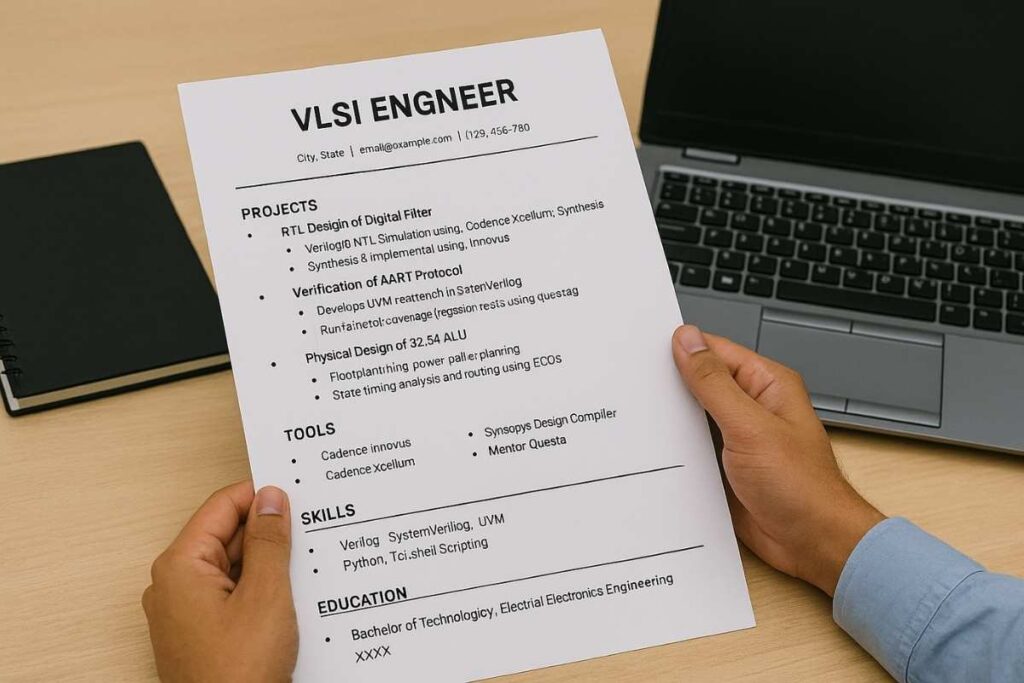
Building a Strong VLSI Portfolio and Resume
Your resume must highlight:
- RTL / Verification / PD projects
- Tools used
- Coding skills
- Problem-solving ability
- Testbench development
A strong portfolio can help you stand out even if you are a fresher.
Final Tips for ECE Student to VLSI Engineer Transformation
Here are some expert suggestions to accelerate your journey:
- Practice HDL coding every day
- Build at least 2–3 industry-level projects
- Follow VLSI interview questions regularly
- Stay updated with semiconductor news
- Join a good training institute for guidance
- Never skip tool-based labs
With consistent effort, any ECE student can confidently become a skilled VLSI engineer.
Conclusion
The transition from an ECE Student to VLSI Engineer is not difficult when you have the right roadmap. South Indian graduates have huge advantages because Bengaluru and Hyderabad are semiconductor hotbeds. With proper skills, training, and guidance, your VLSI Career can take off faster than you imagine.
If you’re looking to start your journey, ChipXpert stands strong as one of the Best VLSI Institute in Bengaluru, offering tool-based training, live projects, and complete placement support.
Your VLSI future starts today, take the first step.
Share your question in comments or talk to our mentor team for batch guidance.
Need Fee, Duration, or Demo Class Details?
Talk to our admin team for the latest batch plan and career guidance.
Contact Admin TeamAsk the Admin Team
Drop your basic question in comments: eligibility, prerequisites, tools, fee range, and placement support.
Our team reviews and responds regularly.