

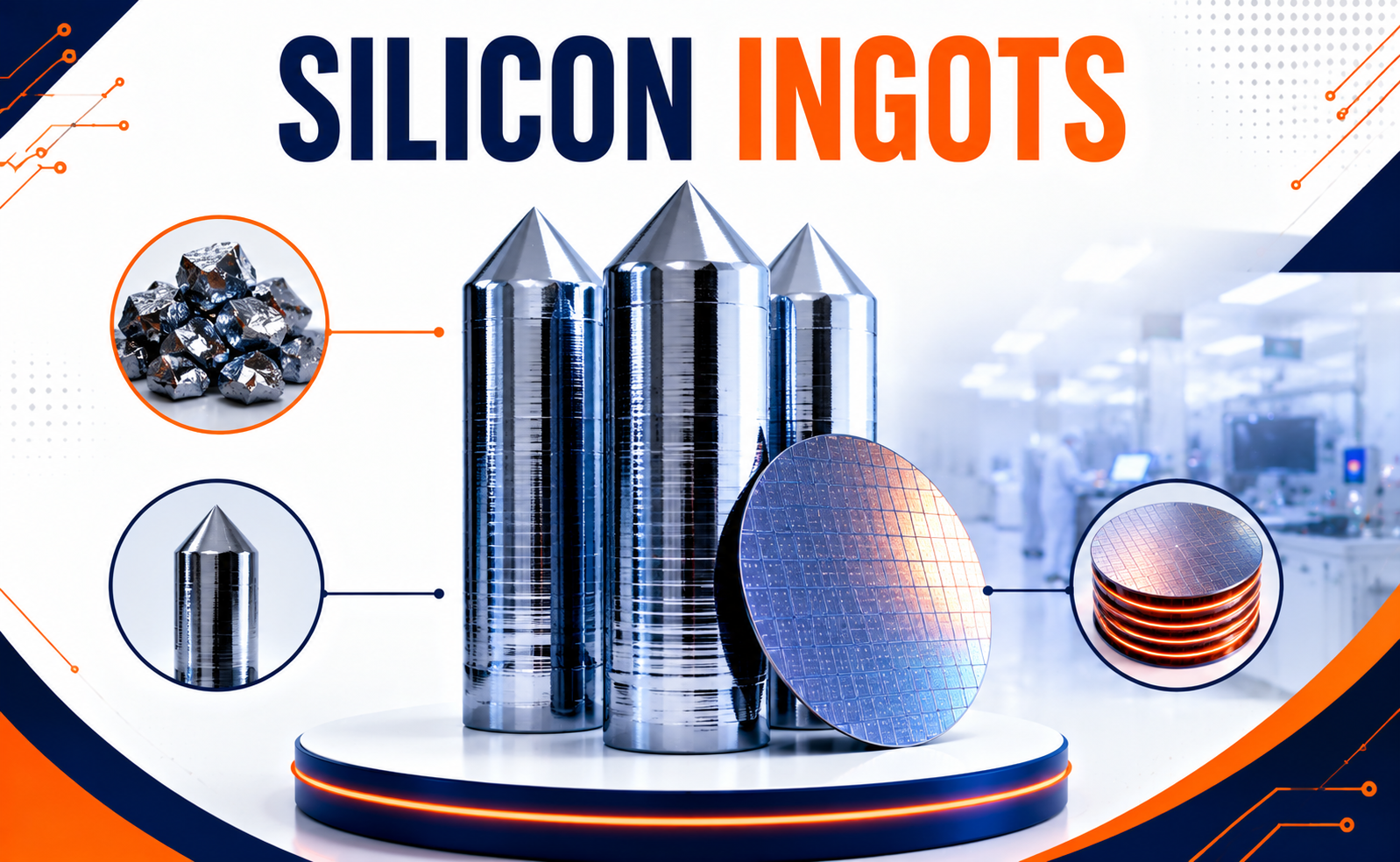
Every semiconductor device from smartphones and laptops to artificial intelligence (AI) processors, electric vehicles, and advanced medical equipment starts with one essential material: high-purity silicon. Before silicon becomes the thin wafers used in chip fabrication, it is first grown into large cylindrical crystals known as Silicon Ingots.
Silicon ingots are the starting point of semiconductor manufacturing, providing the crystal structure required to produce defect-free wafers. The quality of these ingots directly impacts wafer performance, manufacturing yield, and the reliability of integrated circuits. As semiconductor technology advances toward smaller process nodes and larger wafer sizes, producing ultra-pure and highly uniform silicon ingots has become increasingly critical.
What are Silicon Ingots?
A Silicon Ingot is a large, single-crystal cylinder of ultra-high-purity silicon used as the raw material for manufacturing semiconductor wafers.
These ingots are produced by carefully growing a single crystal from molten silicon under tightly controlled conditions. Once grown, the ingot is sliced into thin wafers that undergo hundreds of semiconductor fabrication processes.
Why Silicon Ingots are Important
Silicon ingots determine the quality of every wafer used in semiconductor manufacturing.
Key advantages include:
- High crystal uniformity
- Excellent electrical properties
- Low defect density
- High mechanical strength
- Superior thermal stability
- Consistent wafer quality
- High manufacturing yield
- Support for advanced semiconductor process nodes
Applications of Silicon Ingots
Silicon ingots are the foundation of nearly every semiconductor device.
Logic Devices
Used to manufacture CPUs, GPUs, AI accelerators, and microcontrollers.
Memory Devices
Essential for DRAM, NAND Flash, SRAM, and emerging memory technologies.
Power Semiconductors
Provide wafers for power MOSFETs, IGBTs, and power management integrated circuits.
MEMS and Sensors
Support the fabrication of accelerometers, pressure sensors, gyroscopes, and imaging devices.
Photovoltaic Cells
Lower-grade silicon ingots are also widely used in the production of high-efficiency solar cells.
The Future of Silicon Ingot Technology
As semiconductor manufacturing advances toward sub-2nm technologies and increasingly sophisticated device architectures, silicon ingot technology continues to evolve.
Emerging innovations include:
- Larger-diameter silicon ingots for next-generation wafers
- AI-assisted crystal growth process control
- Improved defect detection and crystal inspection
- Enhanced crystal purity through advanced refining techniques
- Smart manufacturing systems for real-time process optimization
- Sustainable and energy-efficient crystal growth technologies
- High-performance substrates for advanced logic, memory, and power semiconductor applications
Conclusion
Silicon Ingots are the foundation of the semiconductor industry, providing the high-purity single-crystal material from which every advanced silicon wafer is produced. Their quality directly influences device performance, manufacturing yield, and long-term reliability.
As demand continues to grow for AI processors, high-performance computing, electric vehicles, and next-generation communication systems, advancements in silicon ingot manufacturing will remain essential for enabling faster, smaller, and more energy-efficient semiconductor technologies. From crystal growth to wafer production, silicon ingots continue to serve as the building block of modern electronics.
Share your question in comments or talk to our mentor team for batch guidance.
Ask the Admin Team
Drop your basic question in comments: eligibility, prerequisites, tools, fee range, and placement support.
Our team reviews and responds regularly.