

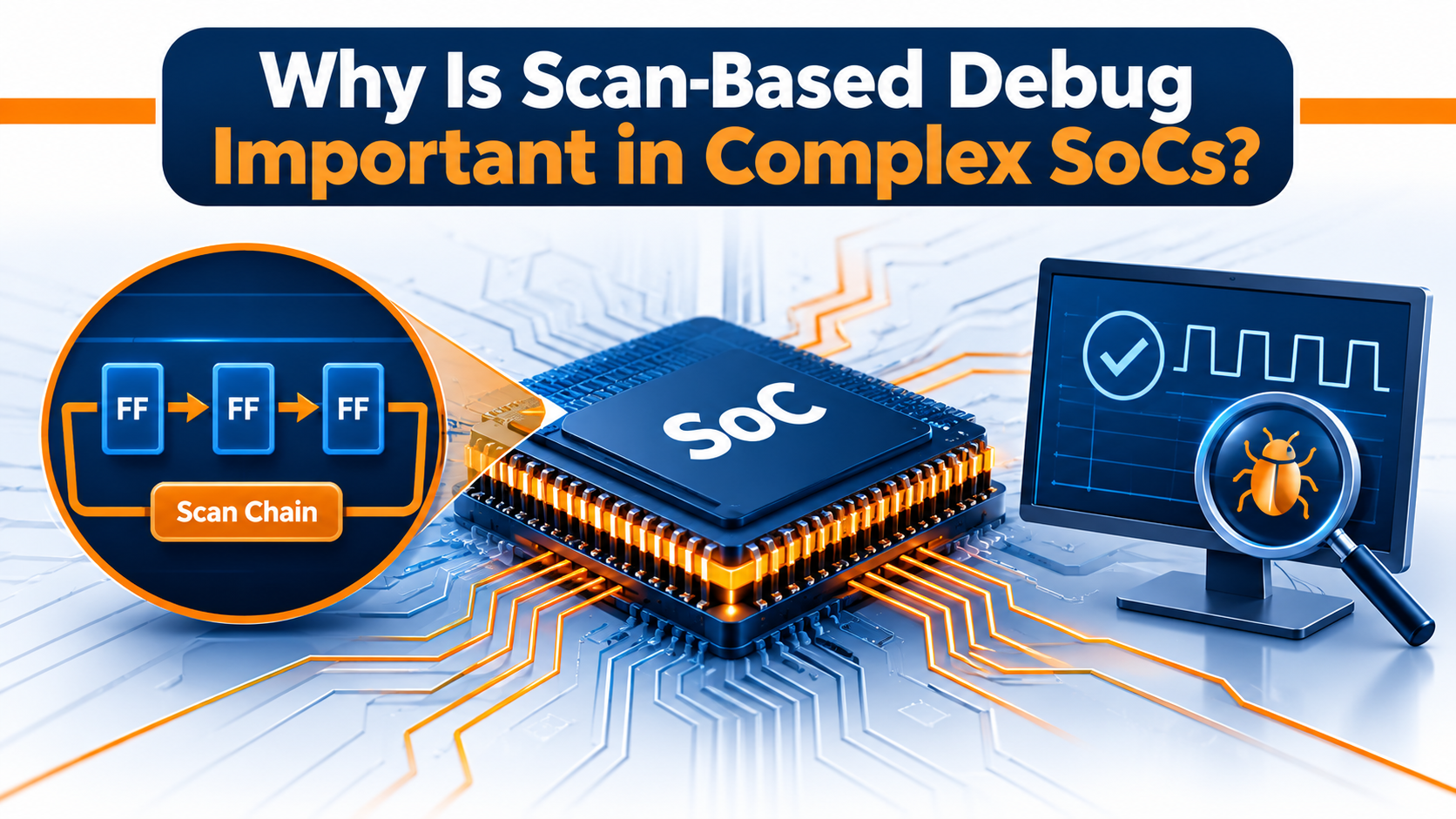
Modern System-on-Chip (SoC) designs integrate multiple processor cores, memory blocks, accelerators, communication interfaces, and control logic into a single chip. As these architectures become more complex, identifying internal hardware failures becomes increasingly challenging.
During silicon validation and post-silicon debugging, engineers need access to internal circuit states to understand why a design behaves unexpectedly. However, many internal signals are not directly accessible through external interfaces.
Scan-Based Debug provides a structured way to access internal sequential circuit states through scan chains. By shifting data into and out of selected flip-flops, engineers can examine internal logic conditions and investigate failures that are otherwise difficult to observe.
Although scan chains are traditionally associated with Design-for-Test (DFT), they can also support debugging activities when appropriate scan access and debug procedures are provided.
What Is Scan-Based Debug?
Scan-Based Debug is a hardware debugging technique that uses scan chains to access internal states of sequential logic circuits.
In a normal functional mode, flip-flops store data and transfer information according to the design’s clock and control signals.
In scan mode, specially designed scan flip-flops allow internal state information to be shifted through a serial scan path.
This makes it possible to load selected test patterns into internal registers and capture their resulting states for analysis.
Main objectives of scan-based debug:
- Access internal flip-flop states.
- Investigate unexpected hardware behavior.
- Identify potential logic failures.
- Examine internal register values.
- Support post-silicon fault diagnosis.
- Improve observability of complex digital circuits.
Scan-based debug is particularly useful when internal circuit behavior cannot be understood through normal processor interfaces or external input/output signals.
How Is Scan-Based Debug Used in Complex SoCs?
Complex SoCs contain multiple interacting blocks, making it difficult to isolate the source of a functional failure.
Scan-based debug can help engineers investigate internal states across selected parts of the design.
Processor debugging
Scan access can help examine internal processor registers and sequential states when supported by the architecture and debug configuration.
Memory controller debugging
Engineers can investigate control logic, state machines, and interface-related registers associated with memory operations.
Bus and interconnect debugging
Scan-based observation can help identify unexpected control states in bus arbitration, transaction handling, and communication logic.
Power-management debugging
Internal state information can help investigate issues involving power-state transitions, reset sequences, and clock-control logic.
State-machine analysis
Scan chains provide access to the flip-flops that represent finite-state-machine states. Engineers can examine captured state information to identify unexpected transitions.
The usefulness of scan-based debug depends on scan coverage, access permissions, design constraints, and whether the relevant internal state is preserved when captured.
What Are the Major Challenges of Scan-Based Debug?
Although scan-based debug provides valuable internal visibility, its implementation and use introduce several challenges.
Area overhead
Scan-enabled flip-flops contain additional circuitry compared with conventional flip-flops, increasing the overall area of the design.
Timing impact
Scan insertion can introduce additional delay on functional paths if scan-cell selection, placement, and implementation are not properly managed.
Clock and reset complexity
Complex SoCs may contain multiple clock domains and reset structures. Scan operations must account for these domains and their operating conditions.
State disturbance
Shifting scan data changes the contents of scan-enabled registers. This can destroy the original failure state if it has not been captured or preserved appropriately.
Large scan-chain size
Large SoCs may contain millions of scan elements. Accessing and analyzing the resulting data requires efficient scan architecture and tooling.
Security restrictions
Scan access can expose sensitive internal information. Production devices therefore require suitable authentication, access restrictions, and lifecycle controls.
Engineers must carefully balance debug visibility, implementation overhead, timing, and security.
Why Is Scan-Based Debug Important for Modern SoC Development?
As semiconductor designs integrate more processing elements and complex control logic, internal fault diagnosis becomes increasingly important.
Scan-based debug supports several stages of SoC development.
Silicon bring-up
After fabrication, engineers can use scan access to examine internal circuit states and investigate initialization problems.
Post-silicon validation
When hardware failures occur on physical silicon, scan-based techniques can help identify unexpected sequential states and potential fault locations.
Functional failure analysis
Captured scan information can provide clues about incorrect state transitions, control-signal behavior, and internal logic conditions.
Manufacturing test support
The same scan infrastructure used for debugging also supports structural testing, including scan-based ATPG patterns and fault detection.
Improved debugging efficiency
Access to internal sequential states can reduce dependence on external observations and help narrow down the source of difficult hardware failures.
Design quality improvement
Information collected during debugging can help engineers identify design weaknesses and implement corrections before product release.
However, scan-based debug is most effective when combined with functional trace, JTAG access, embedded logic analyzers, and other system-level debugging techniques.
Conclusion
Scan-Based Debug is an important technique for investigating internal hardware behavior in complex SoCs. By using scan-enabled flip-flops and serial scan chains, engineers can load, capture, and examine selected internal circuit states.
It helps diagnose state-machine failures, control-logic problems, processor issues, and other hardware-related faults during silicon bring-up and post-silicon validation.
Although scan-based debugging introduces area, timing, security, and state-preservation challenges, it provides valuable internal visibility that complements conventional functional debugging methods.
Share your question in comments or talk to our mentor team for batch guidance.
Ask the Admin Team
Drop your basic question in comments: eligibility, prerequisites, tools, fee range, and placement support.
Our team reviews and responds regularly.